Wednesday, January 22, 2014

The war changed everything, but life went on

Houstonia cerulea in bloom.
People, young and old, kept dying. Couples married. Speakers came to town and drew crowds at the same brick town hall where Abraham Lincoln had spoken in 1860. Eastern bluebirds tweeted. The Great Comet of 1861 lit up the sky. The “army worm” came and went. Blueberries and walnuts abounded. Houstonia cerulia blossomed. 

But on the day Rev. Elias Nason noted the spring debut of the cerulia, also known as bluets or Quaker ladies, his diary also mentioned another phenomenon in his hometown of Exeter, N.H.: Jefferson Davis, president of the Confederacy, was hanged in effigy.

In 1861, the year the Civil War began, Exeter was a town of just over 3,300 people. It was known, then as now, primarily for Phillips Exeter Academy, a prep school with a student body of 110 at the time. Lincoln’s son Robert had studied at the academy the previous year. Amos Tuck of Exeter had served in Congress with Lincoln in 1847-49. The town had a rich political history. It had been the capital of New Hampshire during the American Revolution and, with Tuck as its leader, had grown into a Republican stronghold.

Nason, a local Congregational minister, kept an almost daily account of the events that caught his attention. Remarkably, he also had his diary published at the end of each of the first three years of the war. The first volume was titled Brief Record of Events on Exeter, N.H., during the Year 1861 Together with the Names of the Soldiers of this Town in the War.

The diary shows how war became the focus of activity in the town. As Nason wrote six days after Bull Run, the first major battle: “Remarkably quiet and beautiful day. General topic of conversation – WAR!”

The town’s first concern was answering the call. At the back of the diary, Nason lists 167 men from Exeter who had volunteered for the army before 1861 was out. His entries record recruitment meetings, town votes to support the soldiers and their families, women’s groups forming to raise money and to knit and sew for the soldiers, bands playing, and regiments passing through town on the way to the front.

But Nason’s occupation led him to include many local deaths and marriages in his diary. His curiosity about botany and biology also generates many entries. As a contributor to the weather logs of the Smithsonian Institution, he often recorded barometric readings and temperatures.

Thus, even though Nason seldom writes more than a single sentence on a topic, his diary neatly pairs two themes that only an insider could capture: War changes everything, but life goes on.

I’ve transcribed a chunk of the 1861 diary to give you a taste of it. I’ve also annotated it where I could. (The entire diary can be read here.)

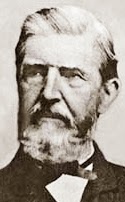
Elias Nason was a naturalist and a writer. 
Before we begin, a few words about Nason: 

He was born April 21, 1811 in Wrentham, Mass., and thus turned 50 years old just as the war began. He grew up on a preacher’s farm in Hopkinton, Mass., where his father tended the farm work. Young Nason learned paper-making at 15 and often worked in a paper mill between periods of study. His academic interests were music, classical and modern languages and botany. He taught school in his early years and entered Brown University in 1831. There he learned Greek and became fluent in French and Italian. Afterwrd he became principal of Cambridge Latin Grammar School, but stayed only briefly before moving to the South.

In Georgia and South Carolina, he became expert in southern flora and began to lecture widely on the subject. “While in the South, as ever after, Mr. Nason was in sympathy with the colored people,” his eulogist wrote. “His life was threatened, more than once, for acting as their defender.” He had begun keeping a diary in 1830, and one entry during his southern sojourn described the hanging of an African-American woman.

Nason was licensed to preach during the 1840s and ordained in Natick, Mass., in 1852. He served as a pastor in Exeter throughout the war. Afterward he bought a 45-acre farm in Billerica, Mass., moved there and expanded it to nearly 100 acres. He named it “Brightside.” He made a living farming, gardening and lecturing. He loved his work and remained at home in either his garden or his study until his death in 1887 at the age of 76.

He introduced his 1861 diary, published in Exeter the following year by Samuel Hall, with these words:

“As the year 1861 will ever be memorable on account of the most stupendous and wickedest rebellion the world has ever known; and as every correct history of the country must devise its sources in a measure from the current events of the individual towns which make up its sovereignty, I have thought proper to select from my Daily Journal a few brief memoranda relating to Exeter, and to embody them; together with the names of our gallant soldiers; in this little brochure which I take the liberty to present as a New Year’s Offering to our patriotic and worthy citizens.”

Jan. 15 – Mrs. Sally Marden dies, aged 89. Dr. George W. Dearborn’s store robbed of watches, jewelry, &c., to the amount of $115.

Jan. 21 – Trees overladen with snow and ice. Scenery beautiful. Rev. Mr. Taylor lectures on London.

Jan. 23 – Mr. Alvan White, powder manufacturer, dies, aged 59.

Feb. 18 – Students in the Academy contribute nearly $70 in aid of sufferers by famine in Kansas.

Feb. 21 – Trees covered with snow and ice; W.S. Abbott, Esq. delivers lecture on “Education” at the Town Hall. Barn of Mr. J.J. Wiggin, destroyed by fire about 11 p.m.

The eastern bluebird
March 2 – High School examined and appears well. The bluebird (amphelis sialis) is heard. Mrs. Abby P. Porter dies, aged 43. Infant daughter of J. Atherton dies, aged 2 yrs.

March 4 – Bell rung and National salute fired for the inauguration of Abraham Lincoln as President of the United States.

March 5 – Magnificent golden clouds at sunset. Francis O. French, Esq. and Miss Ellen Tuck married. [French was the son of Benjamin Brown French of Chester, Lincoln’s commissioner of public buildings, and Tuck was the daughter of Amos Tuck, former congressman and Exeter’s leading Republican.]

March 8 – Ther. 1 at 7 a.m. Bar. 30.50 at 7 a.m.  Wind N.W. Clear. Leverett Saltonstall, lectures in Town Hall on the Questions of the day. –10 Bar. 29.20 at 7 p.m.

March 12 – Annual Election. . . . 397 votes are cast for Berry, and 182 for Stark . . . [Nathaniel Berry, the Republican, won election as governor over Democrat George Stark.]

March 16 – Snow about nine inches deep and much drifted.

March 19 – Annual examination of Phillips E. Academy which appears to be in a very prosperous condition.

Ichabod Goodwin, outgoing governor.
March 27 –  A bass weighing 27 pounds is taken from the river. Rockingham Co. Bible Society, formed. Gov. I Goodwin Pres’t. [Ichabod Goodwin, a Portsmouth Republican, was near the end of his second and final one-year term as a governor.]

April 1 – Bar. 30.51 at 7 a.m. A flock of wild geese flies southward. Cloudy. 2. Furious snow storm all day.

April 4 – James Dwight Nason dies, aged 20 years 5 months.

April 8 – Schools in District No. 1 commence their session. The “Dido” arrives. A boy named McNamara is severely injured by the elevator in the factory.

April 11 – Fast day. Services in the churches. Splendid Aurora Borealis at 9½ p.m.

April 12 – Earth worms make their appearance.

April 15 – The elm is in blossom and frogs are heard.

April 18 – The Trailing Arbutus (Epigeoe repens) appears in bloom.

April 19 – Great excitement in town in reference to the attack on Fort Sumter. Mr. P. Broderick and C. Curtin m[arry].

April 20 – Academy students hoist a flag and fire 32 guns. “Ducit amor patriae.”  [Led by love of country.]

April 22 – A grand mass meeting, in respect to the war, at the Town Hall, Hon. C.H. Bell presiding. Many Patriotic speeches made and money pledged for the support of soldiers. [Bell, an Exeter lawyer and Republican politician, served as governor of New Hampshire in the early 1880s.]

April 24 – The Granite State Bank tenders a loan of $20,000 to the State of N.H. for military purposes. Rockingham Co. Agricultural Society decide not to hold a Fair the ensuing autumn. Ladies of Exeter meet at Town Hall to make clothing for the soldiers. They form a Society and choose Mrs. E.S. Cobbs president. Rev. Mr. Lanphear repeats his sermon on the war at the Town Hall.

April 26 – Jefferson Davis hung in effigy. Houstonia cerulia in bloom.

A shad
April 28 – Mr. E.J. Conner catches in his weir two fine shad, the first of the season. Rain storm.

May 3 – Mr. John H. Thing ploughs up a silver lever watch in good state of preservation after a burial of 9 years.

May 5 – John E.C. Sawyer of the Academy departs for the war.

May 9 – Swallows appear. Voted in a legal Town Meeting to raise a sum not over $5,000 for the benefit of soldiers and their families. Mr. Loring Newton and Miss Almeda Kimball married.

May 12 – Fifty men are now drilling under Chas. H. Bell, Esq.

May 13 – Citizens to form a “Home Guard,” and choose Gen’l Andrew Chase as drill officer. Mr. James Folsom dies, aged 75 yrs. 5½ mos.

May 15 – Currants and strawberries in bloom. The 2d Maine Regt. passes through town. A large company assemble at the depot and a salute is fired.

May 18 – Mr. John M. Mallon, volunteer, and Miss Mary J. Smith married.

May 19 – Minnie M. Fifield dies, aged 3 yrs. 7 mos. Rev. Mr. Nason preaches a sermon to the Volunteers on Psalm 20:5. [“May we shout for joy over your victory and lift up our banners in the name of our God. May the Lord grant all your requests.”]

May 25 – Ladies present many articles of clothing to our volunteers, who leave for Portsmouth, attended by the Band, to join the 2d N.H. Regt. 27 Bar. 29.20 at 2 p.m. Rain storm.

May 28 – Appletree in bloom. Plum and cherry trees do not blossom at all.

June 1 – Beautiful morning; and very warm day. Com. J.C. Long raises a splendid flag.

Gilman Marston, later in the war, as a brigadier general 
June 3 – Hon. Gilman Marston enters on his duties as Col. of the 2d N.H. Regiment. [Marston, of Exeter, was a congressman at the time.]

June 7 – Maine 3d Regt passes through town and receives a collation from our citizens. The Academy Cadets drill under command of Mr. Dubois and make a fine appearance.

June 10 – Citizens present a sword and other equipments to Col. G. Marston.

June 11 – Rockingham Co. Conf. of Churches meet here. Willie Senior dies, aged 8 yrs. The R. Co. Temp. [Temperance] Soc. Meets. Exeter Cornet band serenade the citizens in the evening. A new Catalogue of the Town Library is published. No. of Volumes about 3000.

June 14 – Members of H. School present Bible, pistol, etc., to Charles F. Smith, leaving for the war. Equipments are also presented to Lieut. W.H. Smith. [As a 28-year-old captain in the 2nd New Hampshire, William H. Smith was mortally wounded at Cold Harbor on June 3, 1864.]

June 20 – Mr. Joel Lane dies, aged 69 yrs. 10 mos. Many citizens visit Boston to witness the departure of the 2d N.H. Regt.

June 22 – A gold watch and clothes are stolen from Messrs. Carpenter and Irons while bathing. Mr. Nason delivers a lecture on “National Music,” at the Town Hall, the band attending and performing our national airs.

June 27 – Steamboat “Clipper” arrives.

July 1 – A very brilliant comet seen at 9 p.m., tail about 90 deg. long. Fair weather from June 8 to July 2. [The comet, visible with the naked eye for three months, was known as the Great Comet of 1861.]

July 4 – Fair and warm. Gunpowder freely expended. Sab. School of the 1st Cong. Soc’y celebrate the day with speeches, music, &c., in the grove near the depot. The Elm St. Baptist Soc. also have a pleasant picnic by the river.

July 18 – Business is remarkably dull. Carriage and cotton manufacturing have practically ceased.

July 20 – Bar. 29.60 at 2. p.m. Wind S.W. Mrs. Mary York dies, aged 73 yrs. Showers in p.m. Mr. John E. Wilbur opens a recruiting office at the Town Hall. Schooner “Northern Warrior,” Capt. Kent arrives. [As a captain in the 3rd New Hampshire regiment, Wilbur  was court-martialed and cashiered for conduct unbecoming an officer.]

July 21 – Fair. Col. G. Marston wounded in the right arm at the battle of “Bull Run.” Wm. H. Morrill also wounded in the hand. F.L. Tebbetts taken prisoner. [Marston recovered from his shoulder wound; William H. Morrill, an 18-year-old private in the 2nd New Hampshire, was killed May 5, 1862, at Williamsburg, Va.]

July 22 – Great excitement on account of the recent battle in which a number of our soldiers were engaged. A clear day – most of the ministers and teachers absent.

July 27 – Remarkably quiet and beautiful day. General topic of conversation – WAR!

Aug. 1 – Party of 16 Exeter boys encamp at Hampton Beach. The “army worm” in great numbers suddenly appears in Mr. Gilman’s field. Very little secession sentiment in Exeter.

Aug. 5 – A great war meeting at the Town Hall. An account of the battle of “Bull Run” given.

Aug. 7 – Town vote to pay a sum not exceeding $15 per week to the families of soldiers enlisted.

Aug. 8 – Mrs. Margaret Mason dies, aged 46. Capt. Wilbur’s Company leave for Concord, to join the 3d N.H. A Gas company organized and stock taken.

Aug. 10 – Bar. 26.70 at 9 p.m. Showery. Blue berries abundant – 8 cts. per qt.

Aug. 15 – Col. G. Marston, suffering from his wound, returns to town. Great fears for the safety of Washington.

Aug. 21 – The lads of High School and their teachers visit Hampton Beach. Bar. 30.35 at 7 p.m. Fair. Mr. Gilman Barker has 15 sheep killed by a dog about this time.

Aug. 22 – Messrs. Conners’ Fish and Meat market entered by burglars. Mr. Benj. Swain appointed Police officer, vice, J.A. Fogg. Mr. R. Carter is recruit’g for the 4th N.H.

Aug. 23 – Maine 7th Reg. passes through town on way to seat of war in fifteen passenger cars. Soldiers of Co. D return from Concord on furlough.

Aug. 24 – The “army worm” disappears. Mr. T. Moses in his 95th year visits the town.

Aug. 27 – Miss Ellen Fellowes dies, aged 19½ years. A boy 4 or 5 yrs. old, has his arm broken by the cars. Patrick  Gilroy takes a turtle near the Ox-bow, weighing 26 lbs.; 13 inches long. Rev. Dr. Hitchcock visits this town.

Aug. 31 – Southern corn is selling at $1.25 a bag.

Sept. 1 – Mr. J. B. Wadleigh, late conductor of the B. & M. R.R. dies, aged 47½ years. Mr. John Marsh and wife are burned to death.

Sept. 3 – B.W. Cram and James Jack escape from jail. The former is retaken. N.K. Leavitt, Esq., is appointed Jail-keeper, vice John S. Brown, Esq., resigned.

Sept. 9 – There are now 110 students at the Academy.

Sept. 11 – A refreshing rain occurs after a long drouth. Mr. Peter Leighton digs up a thimble in the rear of “Squamscott House,” marked 1772.

Sept. 26 – Edward Bachelder wounded in the arm by premature discharge of gun. National Fast. Well observed, most of the stores closed and service in the churches. Mr. J. Swasey badly kicked in the face by a horse.

Sept. 29 – The churches take up contribution for the hospitals at Washington; in all about $90. Capt. Edwin Ludington is recruiting at the Squamscott House for the U.S.A.

Oct. 4 – A circus in town. Not largely patronized.

Oct. 5 – Rainy day. Col. Marston leaves for Washington.

Oct. 24 – Dr. E.P. Cummings appointed assistant Surgeon in the Navy. Lieut. O.M. Head and Capt. H.H. Pearson are recruiting. [Edward P. Cummings also served as assistant surgeon to an infantry regiment, the 23rd Massachusetts; Orin M. Head, a 26-year-old private in the 2nd New Hampshire, had been discharged to accept a promotion to adjutant of the 8th New Hampshire; Henry H. Pearson rose to lieutenant colonel of the 6th New Hampshire before his death in May 1864 at the North Ana River. More about him here.]

Oct. 30 – Bar. 29.45 at 9 p.m., pleasant. Ladies have sent 25 India rubber blankets etc. to our soldiers in the 2d Regiment.

Nov. 2 – Severe S.E. storm last night and to day. Highest tide in the river since 1816. Great anxiety in respect to the Naval Expedition. N.H. 3d and 4th Regt. in it. [This was the expedition that captured Port Royal, S.C., southwest of Charleston. The two New Hampshire regiments then joined the federal occupation.]

Nov. 7 – Naval action and Union victory at Port Royal witnessed by many of our soldiers on board the “Atlantic.”

Nov. 10 – Three females baptized in the river just above the “Great Bridge.” Sunset extremely fine. Aster and golden rod still in bloom.

Nov. 12 – Miss Emily F. Greenleaf dies, aged 19 yrs. 7 mos. 14 days. Mrs. Mary Kennedy dies, aged 88. The Hutchinson Family give a concert at T. Hall. Mr. Sam’l Palmer raises a parsnip 25 inches in cir. and weighing 3 lbs. 10 oz. High winds. Walnuts plentiful.

Nov. 14 – Bright and beautiful morning. Ladies – each with a billet of wood for fuel – meet at Concert Hall to knit and sew for the soldiers. One of them has knit 12 prs. stockings for them with her own hands.
Nov. 15 – A few flakes of snow, first of the season, fall in the a.m.

Nov. 16 – Schools in Dist. 1 close. Calvin L. Dearborn of Co. L, N.H. 2d Regt. dies of typhoid fever at Washington.

Pearson
Nov. 22 – Capt. H.H. Pearson’s company leave to join 6th Regt., Col. Mack, at Keene. [Oscar A. Mack was a Regular Army lieutenant and the 6th’s original colonel, but Simon G. Griffin took command in April 1862.]

Nov. 28 – Annual Thanksgiving. Fair and quite dry. Churches open and well filled. Co. B, 3d Regt., mostly from Exeter, dine on turkies and sweet potatoes at Hilton Head, S.C.

Dec. 6 – Snow. Miss Mary E. Tilton dies, aged 37. Sword presented to H.H. Pearson. Bar. 30.65, 2 p.m.

Dec. 12 – Fair. Ladies continue busily at work for the soldiers; they have recently sent to N.H. 2d Reg’t, 120 prs. socks, 30 prs. mittens, 12 prs. wristers, etc., etc. – also one box by Dr. Howe to Missouri, containing 50 prs. socks, etc. They have, moreover, made 175 prs. shirts and drawers for Concord.

Dec. 16 – Col. Marston is dangerously wounded by the accidental discharge of a pistol in the hands of a boy of Lt. Col. Fiske.

Dec. 20 – Many trophies, caps, fans, cotton, etc. received from our soldiers at Hilton Head.

Dec. 25 – Christmas. Santa Claus, well filled stockings and Christmas Trees present their annual store of “good things” to the children. Mr. Joseph T. Porter and Miss Ann M. Wiggin, married. The Unitarian S. School have a very pleasant meeting at the house of Charles Burley, Esq.

Dec. 26 – Ther. 8 at 7 a.m. – clear and cold – fine sleighing. Mrs. Eliza Barlow dies, aged 35. Our soldiers from the 8th Regt. at home on furlough. The material of their clothing is wretched stuff indeed! Whose fault?

Dec. 29 – John P. Leavitt dies, aged 64. Rev. Mr. Bird gives an interesting lecture on Syria.

At the end of the diary, Nason characterized 1861 as a “year of treason; year of lofty patriotism; year of battle, agony, death; of progress, liberty; year of tearful sowing for a golden harvest; year of God’s great mercy.”

Monday, January 20, 2014

'Life is a valuable sacrifice but not too great for a country like ours' – Cpl. Elmer Bragg, a Vermonter in Co. E

Earlier this month I spoke to the Green Mountain Civil War Roundtable, which meets in the old Coolidge Hotel in White River Junction, Vt.

Cpl. Elmer Bragg, 9th NH Infantry
The Coolidge is fun: On the walls of the Vermont Room, where the group meets, is a lively mural painted in 1950 by Peter Michael Gish. Its theme is the state’s history, and the style evokes the work of Mexican muralists of the period just before Gish painted it. He lived at the hotel and created the mural in exchange for room and board.

Civil War roundtables are daunting audiences for a historian. The war is a vast subject, and members of these groups often know more about it than their speakers do. For someone like me, who has focused mainly on New Hampshire’s war experience, speaking to a Vermont roundtable called for a change of pace.

Fortunately, one of the most articulate soldiers in Our War is a Vermonter who crossed the Connecticut River to serve in the 9th New Hampshire Infantry. His name was Elmer Bragg.

I first learned of Bragg at a 2011 exhibit at The Fells, the summer home of John Hay on Lake Sunapee. Bragg’s descendants, including a doctor in New London, N.H., had lent the estate his letters and wartime keepsakes. After reading just a few snatches of the letters through the glass, I knew I wanted to use Bragg in the book. Years ago, the late New London historian Mather Cleveland transcribed the letters and donated the transcripts to the Rauner Special Collections Library at Dartmouth. That is where I read them in full.

At the Green Mountain Civil War Roundtable, I used the letters again to tell the story of the young man from just up the road.

Elmer Bragg was born in East Plainfield, N.H., in 1842, and soon moved to Quechee with his family. With fellow students from Kimball Union Academy in Meriden, N.H., he marched into Lebanon to enlist in Co. E of the 9th New Hampshire on July 25, 1862. In Our War, I write about Cpl. Bragg’s company in two chapters that show the contrast between green and veteran troops.

Less than a month after mustering, with little training and no ammunition, the men of the 9th found themselves on Arlington Heights, where they could hear firing from the second Battle of Bull Run in the distance. Within days, they were on the march north into Maryland.

Bragg wrote to his parents: “I am glad that I am here for I know that I am needed. Life is a valuable sacrifice but not too great for a country like ours. You would be surprised to know what an army we have. . . . I think Vermont and New Hampshire do not have all the credit they deserve for the bravery of their troops.”

On Sept. 11, still on the move, he wrote his aunt, Sarah Bragg Littlefield: “The probability is, that we are now on the eve of a great and fearful struggle. God alone knows who will here be called to sacrifice their lives to their country’s cause. It may be one; it may be another. But can we not meet all this with firmness, if we put our confidence in an Almighty Arm and go forward under the convictions of duty. I think we can.”

On the way up South Mountain, the men were halted for a lesson on how to load and fire their weapons. They tossed away much of the gear they were carrying, including in some cases their food and blankets.

“I have nothing but the clothes on my back,” Bragg wrote after the battle on the mountain. “My blanket and overcoat, shirts and stockings are all left on the Battlefield. Life you know is worth more than all else. The Captain gave us orders to throw off everything, and fight like men, and we did. . . . You can form no idea of the harrass of the Battlefield. It was only through excitement that I endured it. . . . I felt no kind of fear through it all. I was as calm as if I was out upon a peaceful drill.”

Burnside's Bridge, where Bragg and the 9th New Hampshire fought
on Sept. 17, 1862,  just weeks after mustering.
Two days later, on the morning of Sept. 17, from the bank of Antietam Creek, Bragg again wrote home: “Our forces are now under a hot fire of shot and shell from the Rebel batteries. They fly over our heads like rain. We may be ordered at any time to charge upon them and God alone knows the result. But we are ready.”

Bragg survived the battle of Antietam at Burnside Bridge, named after his brigade commander, Ambrose Burnside.

He wrote his father: “The Rebels were there in force and they had a strong position. Hour after hour the contest raged. The thundering of the cannons and the roar of musketry was a continual clang all day. The slaughter on both sides was fearful. At length two regiments, with the 9th New Hamp. were ordered to make a charge across the bridge. Then the struggle was at its height. . . . You can judge of immense slaughter when I tell you that in 10 minutes, 800 of our brave soldiers were lying upon the bridge and near it, both dead and wounded. But the ‘Greybacks’ can’t stand steel and they gave way. Then we planted the Stars and Stripes upon the opposite bank, and with loud cheers rallied around the old flag. . . . For a new Regiment we have seen very hard times in a short time we have been out here.”

By the spring of 1864, the 9th was a veteran regiment serving in Burnside’s 9th Corps. It was in a northern New England brigade commanded by Simon G. Griffin of Keene and including three New Hampshire regiments, two from Maine and the 17th Vermont. On April 28, 1864, Elmer Bragg described the men’s march through Washington on the way to Virginia.

Gen. Ambrose Burnside, 9th Corps commander.
“As the Corps passed through the city the President and Gen. Burnsides stood on the balcony of the Willard Hotel, and any number of Senators and Members of Congress were near the Capitol and White House to welcome the troops who had been in the department of the West. I was surprised to see how careworn the President was looking for he seemed to be really ill, and who can wonder that this is the case in times like the present? . . .

“We received a harty welcome from the citizens of Washington and thousands of people of every class crowded in the side walks to see Burnsides army. Though we had seen rather rough times I believe that we all felt as proud as though we were fancy troops who had never seen hard service. There is an honest pride in feeling that one is doing something if it be but very little, is there not?

“When we were passing through one street I heard a Gentleman who was sitting in a Carriage nearby remark as the regiment was passing ‘New England troops-God Bless them’! . . .

“Of course ’tis all a mystery with us where we are now to act whether directly on Richmond or elsewhere. Time will reveal, and what matters it if we are doing our duty as best as we can? As we move on to meet the enemies of Freedom we go with a sacred trust on our hands, and if we are true men and Brave soldiers we can meet duty wherever it calls and far above the smoke and carnage of the Battlefield a righteous peace will ere long shine down on a free and happy people.”

On their way to the Wilderness, the men passed the old Bull Run battlefield, where the Union army had suffered defeats in 1861 and 1862. Like many soldiers before and after him, Bragg could not resist describing what he saw there:

“It will be a great many years before the marks of Old Bull-Run will be effaced though thousands and thousands of visitors have been over the field to carry to their Northern homes mementoes of the battles on that ill fated field. Wrecks of Ambulances, dismounted pieces of Artillery too large for a curiosity gatherer to carry off, broken muskets, rusty bayonets, fragments of exploded shells & solid shot still lie and will lie in mixed confusion telling passers-by of the awful destruction of war, and yet how feebly! For the dying groans and death struggles of the thousands who were called to die on the field are hushed and all are enclosed neath the green sod.”

On the march, Bragg was surprised “to see what an immense body of troops, Cavalry and Artillery are continually moving up to the front. . . . . The Army of the Potomac is today larger than ever before and under Gen. Grant will prove a serious obstacle to Gen. Lee. Movements are already being made and ere many days pass there may be a battle of as great magnitude as there has ever been fought on the Continent.”

Bragg kept a diary, bless him, and it you can read of his regiment’s movement toward this fate:

May 3, 1864 – Orders to move in the morning

May 4 – The whole of the Brigade except the 32nd Maine & the 9th move on.

May 5 – Break camp 4:30 and march on a line with the R.R. 20 miles to Rappahannock Station. Go into 
camp pretty well tired out.

Walter Harriman, colonel of the 11th New
Hampshire and a candidate for governor
of the state in 1863, was captured in the
Wilderness and held prisoner for five months.
May 6 – Off again this morning about 6 o’clock and as the Me. Boys (a new regiment) went rather slow we took the lead. Heavy firing heard as we near the Rapidan. A brisk engagement going on all day at the front. Col . Harriman missing. [This was Walter Harriman, colonel of the 11th NH, and he had been captured in the Wilderness.]

May 7 – Sleep at night on the field. In forenoon we move up to the front where we threw up breastworks and waited for the enemy. . . . Heavy charge just after dark by Rebs.

May 8 – The loss on our side in the three day fight at Chancellorsville reported at 18,000. In the morning we went into the old fortifications of Hooker and remained in line of battle all day. . . . God Grant, we may soon believe great success.

May 9 – Relieved this A.M. by a negro Division. We marched with the teams about 4 miles towards Fredericksburg. Gen. Sedgewick reported killed but hope it will not prove true. [Gen. John Sedgwick was indeed dead. He was outraged at his staff for trying to duck and dodge rebel bullets from 1,000 feet away. “I’m ashamed of you, dodging that way. They couldn’t hit an elephant at this distance,” he said. A moment later he fell dead with a bullet hole below his left eye.]

May 10 – Marched about 8 miles in the afternoon to the front about 2 miles to the left of Spottsylvania Court House. Formed a line of Battle with Regiment under artillery fire. Staid all night in a rifle pit & the firing comparatively still.

May 11 –Toward night we moved to the rear for a while. Drew fresh beef. Returned to the pit again by dark where we staid all night up at the front.

May 12 – At the light the whole front line advanced on the enemy’s works and our regiment was engaged early. I was wounded near the left temple and in the breast (a slight bayonet wound in the breast) taken prisoner with several others, taken to the rear, under guard.

May 13-14 – I am stopping in a piece of woods. . . . Nearly 150 of our wounded men are here. . . . I am quite comfortable and hope to be soon well again. ’Tis sad to see how some of my comrades are suffering in the hands of the enemy.

May 14 – Spent the day with the rest of the wounded in the woods, and busied myself in washing and cooking us food. Several Rebel surgeons came over to perform amputations.

Back in Quechee, Bragg’s family did not know at first what had happened to him.

On June 10, 1st Sgt. Franklin Burnham wrote Bragg’s father William in response to his queries. Burnham said he had seen nearly every dead face on the battlefield where the 9th had fought and not found Elmer. “I am almost certain that he was not killed nor so badly wounded as to be unable to help himself. Most of the men think he was taken prisoner. Elmer would be the last one to run, and the last any of us now present saw of him he was in the front rank and even beyond banging away at the Johnnies on our front, and quite likely did not see that we were out-flanked till it was too late to skedaddle. One of our men who was wounded and left on the field said when we brought him off that before he was hit he saw Elmer suddenly turn round and lay or drop down with a wound in the face, and on the strength of this we at first reported him wounded.”

In August the handwriting in Bragg’s diary became fuzzier and fuzzier. A typical entry read, “I hope to be well soon, but things are slow.”

In mid-month he was paroled and sent to the naval hospital at Annapolis, Md. From there he wrote his father with details of his capture and imprisonment in Richmond. He had been robbed by the man who bayoneted him, losing his knife, stockings and rubber blanket. The man cut his pocket and took the pocket watch his father had lent him. Elmer promised to pay his father back for the watch and wrote his sister: “Father will never lose a cent if I can ever get enough.”

He had allowed a rebel surgeon to remove the ball from his head, but the wound still hurt. “Head ache troubles me, and often I am crazy for two or three hours and sometimes I am taken blind to last a few minutes,” he wrote.

His father arrived at the hospital on Aug. 19 and found his son comfortable but ill and hard to recognize. For some reason, William Bragg couldn’t stay. The next letter in the Bragg file was written the next day by Maria Hall, one of Elmer’s nurses, to William Bragg. It read:

“But yesterday you were with us & enjoyed the pleasure of seeing your son alive again from Richmond & its prison. But our Father’s word tells us that in the midst of life we are in death – and my heart fails me as I write that the case of your own child is a striking illustration of the truth of these solemn words. The shock of his death came upon me like a thunderbolt. . . . I regret very much that you could not have stayed longer. Elmer told me last night with so much pleasure of your visit – how surprised he was to see you & how glad it made him. He went from my tent back to his quarters & in the night was taken with severe spasms of a peculiar nature. He could not speak at all this morning & seemed as if he were filled and choked up. He lived till about half past ten this morning when he died, as it were choked to death.”

In her letter she enclosed a lock of his hair.

Saturday, January 18, 2014

A new year, a new list

The trove of digitized Civil War-era documents continues to grow. It’s amazing what’s out there. Just the other day I found the diary of a preacher from Exeter, N.H. This will be the source of a future blogpost or two. It’s not strong on narrative, but its “Life goes on” quality is special, as the preacher’s faithfulness in chronicling the world around him.

During the last month I began dipping into my own journals for content, including the recent non-Civil War posts on Dave Van Ronk and Amiri Baraka.

Here are the 10 posts written in the last two months that have generated the most hits. And below that are the top 25 all-time.


8. (tie) He was a friend of mine
   
           Are all wars really the same?
            
           Remembering Lincoln

The top 25 all-time range in hits from 533 to 145. The numbers in parentheses are last month’s rankings:


13. (tie) History’s touch (16)

             Gallery: Faces of the Fighting Fifth (part one) (11)


              A riddle wrapped up in an enigma (19)

23. (tie) A gruesome death (22)

             One school’s proud Civil War heritage (23t)

Friday, January 17, 2014

What the Olustee battlefield really needs

The story on the controversy over the Olustee battlefield in today's New York Times is a missed opportunity. The story frames the debate as a scrap between modern carpetbaggers and mossback southerners over whether a monument honoring Union troops should be placed on state land.

The battlefield is a state park within a national forest. This is a bureaucratic and political nightmare. The proposal to erect a Union statue near the old pro-Confederate monuments at Olustee was bound to stir states'-rights passions. This is the subject of the Times story, which covers it well.

But the story leaves a lot out. For research on Our War, I visited the Olustee battlefield twice in 2012. A chapter in the book deals with the 7th New Hampshire Infantry's experience there on Feb. 20, 1864. With a new African-American regiment on its left, the 7th regiment initiated the attack on a strong rebel line at Olustee. The result was bloody disaster.

The epilogue of my book closes with this paragraph:

"A year after the war’s end, a federal army detachment was sent to Olustee, Florida, to see what had become of the Union dead. Wild hogs had unearthed them, and buzzards had picked their bones clean. The federal troops found bones and skulls spread across the field and skeletal hands and feet protruding from the ground. The soldiers filled two wagons with bones and buried them nearby in a mass grave, which was fenced and marked. In time the fence and marker disappeared. Somewhere on or near the battlefield the mingled dust of black soldiers and white still lies under the earth."

Since the book came out, I've blogged about Olustee twice (here and here). At the risk of repeating myself, here is what should happen at Olustee:

1. The visitors' center should be expanded and modernized, and the battle interpretation should be updated.

2. The battle site should be re-marked to reflect how and where the battle was actually fought.

3. The spot where black and white soldiers' bones were buried, whether it is on state land or not,  should be found and commemorated.

Confederate soldiers' legacy is honored at Gettysburg. Yankee soldiers deserve no less at Olustee.

The day Frederick Douglass came to town (2)

In this continuation of Frederick Douglass’s account of his 1842 visit to Pittsfield, N.H. (part one here), he tells of his encounter with Moses Norris Jr. and mentions an earlier episode involving Norris and George Storrs. A brief primer about these men and about certain events involving them might be helpful.

Norris was 42 years old when the 24-year-old Douglass came to Pittsfield. He was a local lawyer and Democratic state representative at the time.

Moses Norris Jr.
Norris’s clash with George Storrs, an itinerant Methodist minister, had occurred six years earlier on March 31, 1836. The U.S. House was weeks away from adopting a gag rule to block further debate and discussion of abolition in Congress. After preaching against slavery in a Pittsfield pulpit, Storrs was arrested as another pastor was giving the closing prayer of the service. The warrant accused him of being “a transient person” and “a common railer and brawler against the dignity of the State.”

Norris prosecuted the case the same day. The judge convicted Storrs and sentenced him to serve three months at hard labor in Pittsfield’s House of Correction and to pay the $15.80 cost of the prosecution. An appeals court dismissed the case.

Norris was elected to Congress in 1842, the year he met Douglass, and later to the U.S. Senate. As a congressman, he opposed efforts to check the extension of slavery to new states. He accused abolitionists of having “liberty and philanthropy on the folds of their flag [while] arming themselves to overthrow the Constitution and break up the Confederacy.” He died in 1855 and is buried in Floral Park Cemetery in Pittsfield.

We pick up Douglass’s story in the Old Meeting House Cemetery, next to the building where he has just spoken. It is drizzling and he is alone, hungry and tired. He reflects that at least in a cemetery there is “an end to all distinctions between rich and poor, white and colored, high and low.” This account comes from The Life and Times of Frederick Douglass:

The abolitionist George Storrs, a
native of Lebanon, N.H., became
a supporter of the Millennialist
preacher William Miller.
“While thus meditating on the vanities of the world and my own loneliness and destitution, and recalling the sublime pathos of the saying of Jesus, ‘The foxes have holes, and the birds of the air have nests, but the Son of Man hath not where to lay his head,’ I was approached rather hesitatingly by a gentleman, who inquired my name. ‘My name is Douglass,’ I replied. ‘You do not seem to have any place to stay while in town.’ I told him I had not. ‘Well,’ he said, ‘I am no abolitionist, but if you will go with me I will take care of you.’ I thanked him, and turned with hi toward his fine residence. On the way I asked him his name. ‘Moses Norris,’ he said. ‘What! Moses Norris?’ I asked. ‘Yes,’ he answered. I did not, for a moment, know what to do, for I had read that this same man had literally dragged the Reverend George Storrs from the pulpit for preaching abolitionism. I, however walked along with him, and was invited into his house, when I heard the children running and screaming, ‘Mother, mother, there’s a nigger in the house! There’s a nigger in the house!’ and it was with some difficulty that Mr. Norris succeeded in quieting the tumult. I saw that Mrs. Norris, too, was much disturbed by my presence, and I thought for a moment of beating a retreat; but the kind assurances of Mr. Norris decided me to stay.

A plaque in Pittsfeld marks the place where Moses
Norris and Frederick Douglass met.
“When quiet was restored, I ventured the experiment of asking Mrs. Norris to do me a kindness. I said, ‘Mrs. Norris, I have taken cold, and am hoarse from speaking, and I have found that nothing relieves me so readily as a little loaf sugar and cold water.’ The lady’s manner changed, and with her own hands she brought me the water and sugar. I thanked her with genuine earnestness; and from that moment I could see that her prejudices were more than half gone, and that I was more than half welcome at the fireside of this New Hampshire senator.

“I spoke again in the evening, and at the close of the meeting there was quite a contest between Mrs. Norris and Mrs. Hilles as to which one I should see home. I considered Mrs. Hilles’ kindness to me, though her manner had been formal. I knew the cause, and I thought, especially as my carpet-bag was there, I would go with her. So giving Mr. and Mrs. Norris many thanks, I bade them good-bye., and went home with Mr. and Mrs. Hilles, where I found the atmosphere wondrously and most agreeably changed. Next day, Mr. Hilles took me, in the same carriage in which I did not ride on Sunday, to my next appointment, and on the way told me he felt more honored by having me in it than he would if he had the President of the United States. This compliment would have been a little more flattering to my self-esteem had not John Tyler then occupied the Presidential chair.”           

Wednesday, January 15, 2014

The day Frederick Douglass came to town

While researching the antislavery movement in New Hampshire, I ran across Frederick Douglass’s account of his visit to Pittsfield, N.H., in 1842. It is in The Life and Times of Frederick Douglass, the last of his three volumes of autobiography. He was about 24 years old in 1842, had escaped slavery in Maryland and was just beginning his career as a paid orator for the abolition cause.

In this post and the next, I turn the floor over to Douglass to tell the story of this trip to New Hampshire, one of several he would make:

Nathaniel Peabody Rogers,
Concord's abolitionist editor.
“In 1842 I was sent by the Massachusetts Anti-slavery Society to hold a Sunday meeting in Pittsfield, N.H., and was given the name of Mr. Hilles, a subscriber to the Liberator. It was supposed that any man who had the courage to take and read the Liberator, edited by William Lloyd Garrison, or the Herald of Freedom [New Hampshire’s abolitionist paper, published in Concord], edited by Nathaniel P. Rogers, would gladly receive and give food and shelter to any colored brother laboring in the cause of the slave. As a general rule this was very true.

“There were no railroads in New Hampshire in those days, so I reached Pittsfield by stage, glad to be permitted to ride upon the top thereof, for no colored person could be allowed inside. This was many years before the days of civil rights bills, black Congressmen, colored U.S. Marshals, and such like.

“Arriving at Pittsfield, I was asked by the driver where I would stop. I gave him the name of my subscriber to the Liberator. “That is two miles beyond,” he said. So after landing his other passengers, he took me on to the house of Mr. Hilles.

“I confess I did not seem a very desirable visitor. The day had been warm and the road dusty. I was covered with dust, and then I was not of the color fashionable in that neighborhood, for colored people were very scarce in that part of the old Granite State. I saw in an instant that, though the weather was warm, I was to have a cool reception; but, cool or warm, there was no alternative left me but to stay and take what I could get.

“Mr. Hilles scarcely spoke to me, and, from the moment he saw me jump down from the top of the stage, carpet-bag in hand, his face wore a troubled look. His good wife took the matter more philosophically, and evidently thought my presence there for a day or two could do the family no especial harm; but her manner was restrained, silent, and formal, wholly unlike that of anti-slavery ladies I had met in Massachusetts and Rhode Island.

Frederick Douglass
“When tea-time came, I found that Mr. Hilles had lost his appetite and could not come to the table. I suspected his trouble was colorphobia, and though I regretted his malady, I knew his case was not necessarily dangerous; and I was not without some confidence in my skill and ability in healing diseases of that type. I was, however, so affected by his condition, that I could not eat much of the pie and cake before me, and felt so little harmony with things about me that I was, for me, remarkably reticent during the evening, both before and after family worship, for Mr. Hilles was a pious man.

“Sunday morning came, and in due season the hour for meeting. I had arranged a good supply of work for the day. I was to speak four times: at ten o’clock a.m., at one p.m., at five, and again at half-past seven in the evening.

“When meeting-tome came, Mr. Hilles brought his fine phaeton to the door, assisted his wife in, and, although  there were two vacant seats in his carriage, there was no room in it for me. On driving off from his door, he merely said, addressing me, ‘You can find your way to the town hall, I suppose?’ ‘I suppose I can,’ I replied, and started along behind the carriage on the dusty road toward the village. I found the hall, and was very glad to see in my small audience the face of good Mrs. Hilles. Her husband was not there, but he had gone to his church. There was no one to introduce me, and I proceeded with my discourse without introduction. I held my audience till twelve o’clock – noon – and then took the usual recess of Sunday meetings in country towns, to allow the people to take their lunch. No one invited me to lunch, so I remained in the town hall till the audience assembled again, when I spoke till nearly three o’clock, when the people again dispersed, and left me as before. By this time I began to be hungry, and seeing a small hotel near, I went into it and offered to buy a meal; but I was told ‘they did not entertain niggers there.’ I went back to the old town hall hungry and cold, for an infant ‘New England northeaster’ was beginning to chill the air, and a drizzling rain to fall. I saw that my movements were being observed from the comfortable homes around, with apparently something of the feeling that children might experience in seeing a bear prowling about town. There was a graveyard near the town hall, and, attracted thither, I felt some relief in contemplating the resting-places of the dead, where there was an end to all distinctions between rich and poor, white and colored, high and low.”

[To be continued in next post.] 

Monday, January 13, 2014

Amiri Baraka, 1984

Amiri Baraka’s New York Times obituary acknowledged the public’s ambivalence toward the poet earlier known as LeRoi Jones. He was, the reporter Margalit Fox wrote in her lead paragraph, “a poet and playwright of pulsating rage, whose long illumination of the black experience in America was called incandescent in some quarters and incendiary in others.”

Amiri Baraka
His death last Thursday reminded me of an afternoon nearly 30 years ago when I heard him speak at Harvard. Bombast, prejudice and anger fueled his talk, but it was neither incandescent nor incendiary. More like tired and pathetic.

I’m going to share some of this diatribe, which I wrote up in my journal that day, but first a little context is in order. Baraka’s appearance came on Oct. 19, 1984, toward the end of the campaign between President Ronald Reagan and former vice president Walter Mondale. Jesse Jackson and his Rainbow Coalition had made a minor burst earlier that year during the presidential primaries.

I was a 38-year-old Nieman Fellow at Harvard. A student publication had asked me to write a piece comparing college students in 1984 with those of my college days. I went to see Baraka in part to observe the students’ reaction to him.

I had already done some reporting for this piece, speaking with veteran professors about the changes they had seen among their students. One involved how current students read and regarded Henry David Thoreau’s Walden.

Like many early boomers, I had made a pilgrimage to Walden in the early ’70s. Although I was a little disappointed to find the pond itself a suburban recreation area rather than a remote spot in the woods, this didn’t detract from my interest in Thoreau. For me, he was someone who had plumbed the meaning of life, the foibles of humanity and the particulars of nature, all in an American context. He still had something to say.

The site of Thoreau's cabin at Walden, 1972. The plaque stood just above the chimney foundation. The legend on
the plaque, from Thoreau's poem "Smoke," read: "Go thou my incense upward from this hearth." 
When I asked how the students of 1984 read Walden, the English professor I interviewed said they had a different reaction: They wondered how Thoreau got away with it. How was a guy like that ever going to get a good-paying job?

The first thing you noticed when you entered the upstairs classroom in Sever Hall where Baraka spoke was a table full of trinkets and pamphlets for sale. It reminded me of the shilling that used to go on at Elvis Presley concerts.

Not too many students came, and the ones who did seemed to expect to be amused.

Baraka warmed to this task. He saw himself, in his art and in his politics, as a black revolutionary. He professed to believe that on the day black people ceased to think equality was coming, America would burst into flames. Ever since its peak in the 1960s, he said, the black movement had been marching lockstep backward. What was missing was “a fist of popular organization to smash monopoly capitalism.” Instead, too many young people were embracing the Know-Nothing conservative right and the “raucous jingoism” of Ronald Reagan.

Despite reservations about Jesse Jackson, Baraka said Jackson had provided “a spark of life where none existed.” At least he had moved the campaign to the left. He was certainly preferable to “Ben Vereen dancing for Ronald Reagan” and Me Generation television viewers seeing blacks as “middle-class folk,” butlers, pimps and “the little black kid with white parents.”

Reagan and Mondale debate in 1984. Baraka professed to see them as "two murderers coming at you in the night. "
As for the mainstream presidential candidates, Baraka saw little difference between them. Mondale he pronounced “an arrogant racist sucker,” someone whose only potential worth was to stop Reagan. But Mondale was so close to Reagan ideologically that he couldn’t “grab him by the throat and dash him to the floor.”

The candidates were “two murderers coming at you in the night,” Baraka said. The difference was that Reagan was slicing your jugular vein with a razor before you knew it while Mondale knocked on the door and talked to you “like some kind of magazine salesman or something.” You turned your back and he took out his razor, but by this time you had your crowbar in your hand.

1984 Democratic candidates (from left): Gary Hart, Walter Mondale, John Glenn. George McGovern, Jesse Jackson.
In closing Baraka turned on the Rainbow Coalition, wondering why it was playing no role in the campaign now that Jackson was out of the race. He worried that it was just another middle-class venture in the end, a movement of middle-class blacks struggling to be near whites because they wanted to be like whites.

My journal captures a too simple reaction on my part to Baraka’s appearance. I had been in Augusta during the 1970 race riots and the ensuing days of martial law there, and I understood the anger that caused the uprising. But my own reading of recent history was that non-violence had achieved far more for civil rights than fire in the streets. As for Baraka, he had just turned 50 when I saw him but seemed like a relic. He clung to a distorted view of the past, spoke out of bitterness and made stark metaphors to shock and provoke.

He also misread his audience or, possibly, didn’t care what the students thought. They cheered and applauded certain turns of phrase, but the idea of any of them taking to the streets “to smash monopoly capitalism” was ludicrous. Their anxieties were about finding their places in the system, not changing it.