Tuesday, August 25, 2015

6. 'heavy firing in the Afternoon towards York Town'


In a March 14, 1862, circular to the Army of the Potomac, Gen. George B. McClellan assured his troops: “The moment of action has arrived.” His men were trained, hardened and ready. But how ready was their commanding general?

You have to read between the lines of the diaries of soldiers like Cutler Edson and Eldad Rhodes to get a true picture of the futility of the first month of McClellan’s Peninsula campaign. Edson was a 42-year-old bugler, Rhodes a 21-year-old sergeant in the 5th New Hampshire Volunteers. It was not what they did during April 1862 but what they didn’t do that told the story of McClellan’s siege of Yorktown, Va.

Musicians did double duty tending to the sick, wounded and dead. Naturally caring and old enough to be the father of many men he served with, Edson embraced this role. His diary shows firsthand the consequences of shipping a large army to a warm, pestilent climate and expecting it to thrive. He passed many nights – “knights,” as he called them – holding the hands of sick and dying comrades.

Rhodes’s daily life was different: he dug and lugged, building roads and barricades. His weapons were a shovel and a pick. This betrays a different but no less damning result of McClellan’s failure to seize any advantage his army’s swift move to the Peninsula had gained.

Distant artillery shelling kept both men up some nights – the sound of battle but no actual battle. Then, a month into the campaign, they awoke one morning and the Confederate army was gone. It was also reinforced. And its leaders had developed a strategy to defend Richmond, their capital, from an attack from the east.

A Civil War steamer of the kind  that joined the motley flotilla that transported troops to the Peninsula
Cutler Edson’s diary

Friday, April 4, 1862: got up this morning and went to Camp California to Mr Richards and got my  pay. When I returned the Regt was all redy to go abord the Boat Stemer Croton. just wrote a letter and sent home to wife. We left here about 3 oc. we have 300 on bord this boat. the rest of the regt  in 2  others. passed fort Washington on the Md shore. this is a  beautiful Fort  built of  stone.  

We then passed Mount Vernon on the Va side, a lovely looking place for the father of our country to sleep. had a fair view of the old mansion. it is a long brick building with several smaller out houses with a large number of fruit trees. Sailed till about 9 oc and anchored for the knight.

Mount Vernon in 1860
Eldad Rhodes’s diary

Friday, April 4, 1862: Weather as calm and scerene as the morn of Creation; – we marched down town and got aboard the Government Boat Danalson; and in company with many other Steemers and schooners Steemed down the grand old river Potomac; – passed Mt Vernon at eve the home of Washington. Saw the ancient mansion and the tomb of Washington and here the Potomac sighs beside the Patriot Heroes grave.

Saturday 5: Weather stormy. we were at anchor most of the night; – I was Sargt of the guard; – we got into the Bay at noon, steemed down the Bay at a slow rate for we had a good load. on guard all night

Cutler Edson’s diary
Saturday 5: a little rainy & Foggy which presents a very bright prospect from the shore. Past Port Tabacco on the Md side the river is quite wide here and we had but a very faint view of it. Salt Watter gets back nearly to this place. began to grow rough and we anchored off St. Maryes river.

Sunday 6: Started this morning about 8 oc. a very fine day for saling threw the Chespeke Bay. had preaching on board by Bro Wilkins from the text take my yoke upon you and learn of me &c. Anchored at Fortress Monroe  about dark. this seams to be quite a place. seanery in the harbor this eve is delightful.

Eldad Rhodes’s diary

Sunday 6: we reached Ft Munroe in the afternoon. layed by for orders and coal and then steemed up the Bay toward York River; – Saw many vessels and Troops at the Fort.

Monday April 7, 1862: Weather stormy and cold. we ran up the York River, landed on the beach, waided a shore, marched back to a pine wood and encamped. everybody buisy. heavy guns are heard at YorkTown where the Rebels are cornered by McLellan.

Cutler Edson’s diary

Monday 7: wrote to wife yesterday. lade here in the harbor all day waiting for cole. this has been a cold stormy bad day. we have nothing but raw meet and hard crackers to eat and sleeping any where that we can get a chance, yet I dont feele to complain.

John Tyler
Tuesday 8: orders came this morning to land us at Hampton Rodes about 3 or 4 miles from here and then march to York town. When we got there the order was countermanded and they are to cary us there in this boat. we returned to Fortres Monroe and then took in cole.  Hampton rodes has bin pritty much all distroyed by fire by the rebels. Saw the old mansion of vic President Tyler.* Newport News is about opposet this place. these hav all bin seans of battle and blood shed but is all in the hands of the union now.

[*John Tyler, the 10th president, lived at Sherwood Forest Plantation in Charles City on the James River from 1842 until his death on Jan. 18, 1862, less than three months before Edson steamed past his house.]

Eldad Rhodes’s diary

Tuesday 8: Weather still clowdy and stormy. Remained in camp with nothing to molest or make us afrade. Many troops are stiring – and wagons moving to and from our Grand Army near York Town.

Wednesday 9: I was detailed as Sargt on the road today laying logs to support the wagons. rained in Afternoon. got very wet. returned to my rubber tent. found a good fire awating.

Thursday, April 10, 1862: wrote a letter home &c. heard heavy firing in the Afternoon towards York Town; – am to work on the road tomorrow.

Friday 11: Working on the Road; Freedom* came over to see me as the 2nd Regt N.H.V. were stationed near by; – the boys were looking well. I went over in the evening and had a good long chat with Freedom.

[*Freedom Rhodes, a sergeant in the 2nd New Hampshire, was Eldad’s brother.]

Cutler Edson’s diary

Friday 11: Started this morning about 3 oc. and anchored at Ship point about 6 oc this morning where we are waiting for further orders. ordered to  land just below Ship point about 9 oc where the shore is  lined with soldiers going toward york town. we have bin on the water 1 week and we was very glad to get our feet on teriferma again.

Saturday 12: Saw Esq. Liscom* from Lebanon. was glad of the privelige of meeting an old acquaintance. we are camped near the beach where we get oisters and clams which go first raight after living on raw meat & hard bread.

[*Elisha P. Liscomb, a founder of the Northern railroad and a justice of the peace, lived in Lebanon, N.H. President Lincoln had appointed him allotment commissioner for the state in March 1862. In that capacity he traveled to the front to check on sick and wounded soldiers, but his main task was to bring home soldiers’ pay to support their families. Liscomb no doubt took a special interest in the 5th, as his son Charles was a 19-year-old corporal in Company C. Charles Liscomb was later wounded at Antietam and died of disease while the 5th was stationed at Point Lookout, Md., guarding Confederate prisoners.]

Eldad Rhodes’s diary

Saturday 12: still working on the Road. the 2nd are still in camp neer by; had a hard days work. Confound this way of working for the Union. we hope soon to be relieved.

Sunday, April 13, 1862: we are to desecrate the sabath by working on the Road; – and this by Gen Howard, A pretended Christian. the 2nd moved today.

Cutler Edson’s diary

Sunday 13: by the request of the President we had prayer to day at 12 oc, which was to be threw out the army. it was very appropriate. I enjoyed it very much.

Monday 14: had a good time washing myself & cloaths. orders came from Gen. McLelon to have no bugle calls or drum beting.  the rebels have bin throwing shels wherever they have  heard them.

Tuesday 15: got up feeling poorly this morning. think my constitution is very much broken in  concequence  of the exposure we have had the first 6 or 7 weeks. I hope by the grace and mercys of God that I shal have health and strength to carry me threw the campaign. When I am not well I think much of the comforts of a quiet home.

Lord Cornwallis
May God grant that the time is not far distant when I shal have the privelige of enjoying it. I feel that God is my portion and my all. how comforting & consoling it is to the christian to feele that his treasure is not of this world. A little before morn we had orders to pack up and start in 1 hour. we marched about 6 miles on  to  very near the spot where  Lord Cornwalice delivered his  sword to Gen Washington the 19 of Apr 1776*. this is a large beautiful plane with but few houses present & apple trees are in blossom.

[*Edson was slightly confused on the details. It was Gen. Charles O’Hara, Cornwallis’s adjutant, who surrendered at Yorktown on Oct. 19, 1781. Washington declined the proffer of O’Hara’s sword, deferring to Gen. Benjamin Lincoln, his own second in command.]

Eldad Rhodes’s diary

Tuesday 15: We went on to the Road to work. at about noon we were ordered to march in to camp as our Regt was under marching orders. we left camp about 2 and marched about 6 miles back into the Country toward York Town and encamped.

Wednesday, April 16, 1862: we were in Camp untill 4 OC doing nothing but what most pleased us; – when we were ordered to march we marched back about a mile and encamped for the night. heard fireing at York Town.

Thursday 17: Awoke much refreshed; the sun arose in all the splendor of a Northern Mid Summar. the birds Caroled in the trees with all the melody of Natures Songstress; and the very air seemed to sooth us to rehope. heard heavy fireing occasionaly.

Friday 18: we are still here in Camp sweltering beneath a hot sun. hear fireing every day. on this very ground 80 years ago Gen Bragoin Surrendered to Gen Washington and on this spot Americas destiny was decided in favor of Liberty.*

[*See previous note.]

Cutler Edson’s diary

Friday 18: heavy fireing this morning in the vicinity of York town which commenced about ½ past 1 oc  and was kept up by intervals the rest of the knight. Mr Liscom left here to day for home. the name of this camp is Winfield Scot.    

Saturday 19: 6 months to day since I was mustered in to the Service of the U.S. I went out about 2 miles  where  I could see the rebel works and saw our bateryes shell them. drew our new tents to day. they are quite convenient and we like them very much.

Eldad Rhodes’s diary

Saturday, April 19, 1862: to day is a day ever to be remembered by America. 87 years ago to day the battle of Lexington was fought.  A year ago to day the Mass 6th was fired on while marching the streets of Baltimore by a mob of Rebels.


Henry O. Kent
Sunday 20: Weather still cold and rainy by inervals. was buisy writing a letter to the Republican which I commenced yesterday. don't know how it will take or whether it will take at all with H.O. Kent.*

[*Henry O. Kent was editor and publisher of the Coos County Republican, the weekly newspaper in Lancaster, Rhodes’s hometown. Col. Edward E. Cross had worked at the paper, then known as the Democrat, in his youth. Kent was Cross’s best friend in the 1850s; they regularly corresponded during Cross’s western adventures. Kent also helped the state of New Hampshire organize regiments for the war and had eased the way for Cross’s appointment as colonel of the 5th.]

Monday 21: had a Division Drill under Richardson* in the fore noon which was very fatiguing. had dress parade in the after noon. as usual heard fireing occasionally through the day

[*Brig. Gen. Israel B. Richardson commanded the 1st Division of Maj. Gen. Edwin “Bull” Sumner’s 2nd Corps. Brig. Gen. O.O. Howard’s 1st Brigade in Richardson’s division included the 5th New Hampshire.]

Tuesday, April 22, 1862: we had inspection by a US Officer to day. heard heavy cannonading on the right wing of our forces at York Town; – went over to Gen Richardsons head quarters with documents from our Regt.

Wednesday 23: had a drill in the fore noon. heard occasionaly heavy fireing at York Town; – The Rebels are to make a stand at the best of their ability.

Cutler Edson’s diary

Wednesday 23: Went out with the company on skirmish drill with out playing. the first time I have drilled for nearly 2 months. wrote to wife  today.

Thursday 24: built an oven to day for the left wing, a very large one.* made me a trowel out of a piece of board and found plenty of good clas and poor Brick. Lit it and baked a nice batch of beens for breakfast.

[*Edson was a brick mason.]

Eldad Rhodes’s diary

Thursday 24: had a Regiment drill and very good one too; fireing still goes on daily at York Town. Many of our men are dangerously sick at the Point. the Lieut went down in the evening to visit them. found them very sick.*

[*The first lieutenant in Rhodes’s Company B was Welcome A. Crafts. The hospital was at Ship Point, where the 5th New Hampshire had been the first regiment of Howard’s brigade to land on April 6.]

Friday, April 25, 1862: Joseph Call died at the hospital last night and Robert Cummings died to day at 10 OC and one more will probably die soon.* this is the fruit of our hardships on our march to the Rappahanock and back to Manassas without food and shelter uncared for by the Physicians.

[*Cpl. Joseph Call, a 26-year-old from Colebrook, N.H., died at Ship Point April 23, 18-year-old Private Robert Cummings of Northumberland on April 24. Both were in Company B.]

Cutler Edson’s diary

Saturday 26: Waited upon Bro Strong over to the Brigade Hospital about 1 mile. he was quite sick but stood the walk  better  than I expected. the hospital is one of the rebel Baracks. hope he will soon recover.* just recd letter from Bro & Sister Folsom. am glad to learn that we have got so good a preacher at Enfield. I hop God will abundantly bless & prosper his labours in sanctifying the church and the convertion of many soles. this is my constant and sincere prayer.

the Regt  are out on patrol duty to day. Drummer is over to the hospital getting wood & watter for them and I am here sheltered from the rain in my little tent. I feele very grateful to God for his goodness to me.

[*Pvt. Louis J. Strong was a 20-year-old native of Canada who lived in Enfield, Edson’s hometown. He was discharged disabled six months later.]

Sunday 27: Went to the hospital to help chop wood and brot watter and took care of the sick all day.   the first Sunday that I have bin oblijed to work all day since I came into the army. our hospitals are in Old rebel Baracks but they are fixed up so they are quite comfortable but it is very hard to be sick from home.

Eldad Rhodes’s diary

Sunday 27: we were rousted up early in the morning and orderd to be in readiness to march at 7 OC. we were on hand in Season; – and after a march of 3 miles we came to a halt and made our camps; we are to make fascines or gabions.*

[*The 5th was making fascines and gabions (brushwood bundles and barricades) for use in McClellan’s siege of Yorktown.]

Monday, April 28, 1862: we went out to make our gabions for the first time today – had poor luck – heavy fireing and musketry can be distinctly heard. even the whistle of Cannon Balls and shells can be heard.

Cutler Edson’s diary

Monday 28: this is our pay day. got our pay up to the 1st of March, $24.00. went down to the hospital to see the sick and caried them some Oranges which pleased them very much.

Tuesday 29: choped &  carried wood &  watter for the cooks.
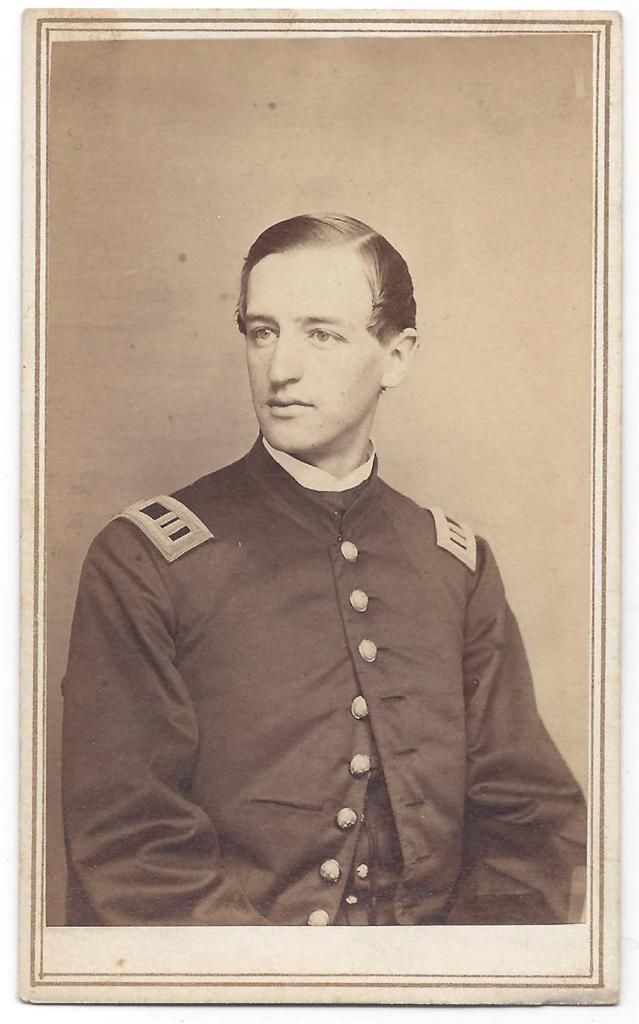

Harrison Young of the 2nd N.H.
Eldad Rhodes’s diary

Tuesday 29: we were at work making gabions. had prety good luck. some Boys from the 2nd were up to day. every thing goes on prosperously. we are out of our place up here in the woods building Eel pots

Wednesday 30: hear heavy fireing at night and during the day. we are still at work and still liked to be.  Sergt Hilliard and Lieut Young were up from the 2nd to day.* had good luck building gabions.

[*Like Rhodes, Sgt. Henry S. Hilliard and 1st Lt. Harrison “Harry” Young were from New Hampshire’s North Country. Rhodes probably knew Young, who was just a year older than him and came from the same town, Lancaster. Young and Hilliard were in Company F of the 2nd New Hampshire. Hilliard left that regiment for an officer’s commission in the 5th in late 1863. He was captured at Farmville on April 7, 1865, during the 5th’s last battle of the war. Young was wounded at the second battle of Bull Run on Aug. 29, 1862.]

Thursday, May 1, 1862: We were up by times and had our quota of gabions out by noon. had a Co inspection at night; – heard fireing during the day toward York Town and beyond. hope Banks will be up in their rear with Mc Dowel soon.*

[*Gen. Nathaniel Banks’s troops were occupied with Stonewall Jackson’s in the Shenandoah Valley. The White House withheld Gen. Irvin McDowell’s forces to protect Washington. McDowell’s absence in particular gave McClellan an excuse to claim Lincoln was thwarting his Peninsula campaign. Many Army of the Potomac soldiers believed this as well. But historians have come down firmly on Lincoln’s side. In the view of most, McClellan mounted the Yorktown siege against a creative but much smaller Confederate force, and his dallying gave the rebels time to devise and strengthen their defense of Richmond.]

Cutler Edson’s diary

Thursday, May 1: Sat up with the sick boys at the hospital last knight. Sent 25 dollars for my self and 30 for Bro Strong home by Mr Liscom. helping about the camps to day.

Friday, May 2: called out last knight at 12 o.c. to go with the wagons to the Regt and get there lugage for they were ordered back to camp and be redy to moove to the front at a moments notice but after every thing was all here the order was repromanded and the Regt returned to there work.

Eldad Rhodes’s diary

Friday 2: We were rousted up at 1 OC in the morning and ordered to be in readiness to march immediately back to our old Camp which we did. we suppose the Battle is to come off soon; – we did not march to battle but did march back to our work; a fools errand.

Saturday 3: We worked getting polls for facines. – Freedom was up to see us from the point. Prof Lowe made a reconnaisance and the Rebels fired at him. A heavy cannonade was kept up all day and evening; the Rebels seem to think they can damage us – poor fools, we will teach them.
The Great Stone Dwelling (now a museum) at the Shaker Village in Enfield, N.H., Cutler Edson's hometown.
Cutler Edson, from letter to Mr. and Mrs. Horace F. Folsom

[Horace F. Folsom was Edson’s pastor back home in Enfield, N.H. The letter was dateline York town, Va., May 3, 1862]

You say you shal expect me home by autumn. that is something I cannot tell but I expect to be home to selibrate the 4th but there seems to be one large cloud between this period and that. If we pass safely through that, I think the struggle will be over and peace soon restored to our distracted nation and we that have come out here to do service and battle for our nation will have the privilege of returning to our quiet homes.

that cloud is the two great contending armyes at this place. we are daily looking for the battle to commence as our army are making great preparations and the enemy are doing the same. I suppose they calculate to do there best here for you know they are pretty much a used up mess and unless they should lick us here and at Corinth I think they will give it up.

There was conciderable fireing along on the line last knight and there is this morning. This is to keep the men from working on the fortifications which is mostly done knights.

Albert G. Cummings
Albert Comins has been promoted 2 months ago. he was put in Sergeant Major and now he has taken another start. he is second Lieut. in Co. A. Mr. Wire is agoing to have his discharge and go home I understand. don’t know but he has started now.*

At 11 oc at knight finds me here agan at the hospital watching around the sick. I1 has died since I was here and I believe he was prepared to meet his fate. There is 2 others that I think must soon fo. I told one of them just now I did not think he could live. he said he wished he had someone to pray with him. I told him I would. I asked him if he was willing to die. he said he was but I fear he is deceived.

A sick bead is no place prepare for this great work. He was very wicked before he was sick and the most of the time since, poor fellow, he hardely knows what he says.

There was part of our sick that were able to be moved [and] started yesterday for N.Y. probably they will get better care there than we can give them here. one of them was Charles Tolcott that used to be with the Shakers.**

There is a great deal of heavy cannonading to knight by the rebels. I can here shells whistle threw the air. think they must fall very near our camp which is about a mile from here. I think little Mc. will be ready to give them all they nead.

It is most 1 o.c. and I must close for the knight and try and try to fill this out tomorrow. I have been quite buisy the most of the time to knight. There is a great deal of work in taking care of 7 sick men.
Sunday morning the 4th. Slept but little last knight. A good deal of fireing all knight but seems quite still this morning.        

[*Albert G. Cummings of Enfield had made first sergeant in November, and his lieutenant’s commission was dated May 12. He was later wounded at Fair Oaks, Fredericksburg and Chancellorsville but served out his three-year term of enlistment and was discharged as a captain. He lived in Harrisburg, Pa., after the war. Thomas Wier enlisted from Enfield at age 43, leaving his daughters with the Shakers. Some months after his discharge, having failed to secure the return of his children, he walked into the Shaker village and shot Caleb Dyer, the head elder, mortally wounding him.]

[**Charles L. Tolcott, a 21-year-old private from Plainfield, N.H., died of disease in Philadelphia.]

Cutler Edson’s diary

Saturday, May 3:  Went to the hospital to knight to sit up with the sick. found some of them very sick.   one had died since I was here  last. I think ther’s  others that will die soon. there has bin a great deal of  cannonaiding threw the knight. wrote to Bro. Folsom. returned to camp in the  morning.
Sunday 4: just had news that York town is evacuated and for us to take 3 days rations and persue them. got all ready to start and orders came to pitch tents agan and stop for the  knight. Bugles blowing, the Band playing, which makes it much pleasanter.

* *

Support crew fills Professor Lowe's balloon with hydrogen.
The “Prof Lowe” in Rhodes’s Saturday diary entry was Thaddeus S.C. Lowe, who was also a native of Coos County in New Hampshire’s North Country. His reconnaissance by hot-air balloon delivered the news – shouted down by his passenger, Union Gen. Samuel Heintzelman, that the rebels were gone.

All the men’s digging, tree-chopping and barrier-building during McClellan’s siege of Yorktown had been in vain. Still, most soldiers put a positive spin on this. Lt. James Larkin of the Fifth New Hampshire wrote to his wife Jenny in Concord: “Once more our army is victorious without a battle. The Rebels have fled before us without a battle and the national flag waves over Yorktown.”

The next day, May 5, the regiment marched to Williamsburg, where the 2nd New Hampshire was among the regiments involved in a sharp battle, but it turned out the 5th was not needed. “I fear that we shall always be the bloodless Fifth,” Sergeant George Gove wrote in his diary.

Such fears would be laid to rest soon enough.

Saturday, August 22, 2015

5.'it blew pritty much all knight but God preserved me and my little tent. bless his name' -- Cutler Edson, 5th NH

[Previous chapter]

March 29, 1862, was the 5th New Hampshire Volunteers’ third day of hard marching near Manassas, Va. The men had hunted their supper – hogs, cows and fowl. An afternoon snowstorm howled into evening. Cutler Edson, a company bugler, wrote in his diary: “this begins to feele some thing like Soldiering.”

Gen. George B. McClellan
For a regiment that had been in the field for nearly five months without fighting a battle, the tramping around, sleeping tentless in bad weather and living off the land turned out to be valuable training for harder days ahead.

This is the fifth chapter of the story of the 5th New Hampshire’s first 15 months as experienced and recorded by Edson and Sgt. Eldad Rhodes. The men’s paths will cross after the Battle of Antietam, but even now their diary entries and letters march to the same beat.

This chapter takes them from their winter home at Camp California through several marches into the Virginia countryside. It closes as they prepare to depart on Gen. George B. McClellan’s Peninsula campaign.

Although there was impatience in some quarters for McClellan to take his mammoth Army of the Potomac into action, he was smart to take his time. Soon enough the 5th would learn whether McClellan’s deliberate ways worked as well when he shipped his marvelous army out to confront the enemy.  

Cutler Edson’s diary

Wednesday Feb. 19, 1862: played at the Generals.* recd a letter from wife. was very glad to here from home once more. Sent home my old diary & a lot of old letters today. have felt very much proffited by reading the beauty of holiness. it is like food to a hungry man. I feele that my whole trust & confidence is in my Savior.

[*Oliver O. Howard, the brigade commander.]

Thursday 20:  Skirmish drill this fournoon. Brigade review this after noon. recd 2 papers from Wife.

Gen. O.O. Howard
Friday 21: had a good time on Skirmish drill. Visited the graves of some of our Soldiers. 17 graves. 2 of them have good Marble Slabs. one bars this inscription: “he was a good Soldier and always don his duty.” I wish it could be said truithfuly so of every Christian. recd a letter from Sister Abbie. Wrote to my good wife.

Eldad Rhodes’s diary

Friday, Feb. 21, 1862: we drilled to day all day. had a hard drill in the afternoon under Gen Howard. expect a grate time tomorrow.

Cutler Edson’s diary

Saturday 22: this is the birth day of the father of our Country. it has bin a holly day with us. his fairwell address was read By General Howard. the Manchester Batery was here and we had a great time. recd a leter from wife & Bro Folsom.

Sunday 23: attended meeting in the 64th NY. enjoyed it very much. have not had the privaleg of the kind in some time. one woman present and prayed, a sight I have not seen for more than 4 months.

Monday 24: General inspection. the hardest rain and hail storm I ever new. it was so severe that we did not get threw inspection. went back to our tents till it cleared up then went out again and before we had time to form a line the wind blew a perfect gail and in a few moments half of our tents were blown flat to the ground. the gail was so powerful that the men could not keep there places and the line was soon broken up and the men got back to there quarters the best they could. 

we wated till 4 OC then went out by companyes and past inspection but it was with difficulty that we marched to the parade ground and back again. it blew pritty much all knight but God preserved me and my little tent. bless his name.

Eldad Rhodes’s diary

Monday, Feb. 24, 1862: Capt Brown has resigned and is going home. Lt Rice is Capt*; we went out for inspection rain and sleet soon came on and we came to Camp. Soon a heavy wind arose and blew every tent in the Regt down with some 10 exceptions.

[*Col. Edward E. Cross had removed Capt. Edmund Brown for incompetence. Lt. Thomas J. Rice, a 33-year-old Bostonian, was transferred from another company and promoted to captain.]

Tuesday 25:  we were buisy in the forenoon repairing damages; – had a drill in the afternoon under Howard. had a hard drill.

Wednesday 26: we had a drill in the forenoon under Capt Rice in the bayonet exercise. had a brigade drill in the afternoon under Howard.

Cutler Edson’s diary

Wednesday 26: skirmish this fore noon. Battalion Drill after noon. gave calls at the Generals. washed my cloaths. done some sowing and so fourth.

Thursday 27: rained hard most all knight but cleared off this morning and the wind is blowing very hard. no drill today. preparing to go on picket to morrow. Wrote to Bro Folsom and sent a paper home.

Letter, Cutler Edson to Mr. and Mrs. Horace F. Folsom

[From Camp California, Fairfax Co., Virginia, Feb. 27, 1862]

Our religious privaleges here are very limited. We have had no religious meeting here for a long time but we expect our Chaplain back soon, then I am in hopes our meetings will revive again. I think we might have had them all the time if he had left it with some one to go on a head and took the lead. I keep up our family devotions which I think has proved a great blessing to me & my little tents company. . . .

When we was on picket last I thought it was the last time that we should have that duty to perform but our turn comes tomorrow again. We are to start in the morning and before our time there expires, we expect to advance on to Manassus with about 160 Regts, which will average about 800 each. This will make a large armey. I hope the sight of so large a force will be sufficient to subdue the rebels there without the use of Shells & Ball, but if not we shall give them a few portions of the latter which has not failed in a single instance of cureing since this year commenced.

We are quite buisy in camp today getting ready for a start and you must excuse a short epistle this time. I send a picture of our noble General in this to my folks. Please forward it with my love to them all. My health is very good and I feele glad that we are going to advance.

Cutler Edson’s diary

Friday 28: Went on picket this morning   Went as far as Edsels hill in to the woods where we made us some shanteys and built fires and made our selves quite comefortable. it was pritty cold but we ware warm enough. marching got here about noon. cold windy knight but we managed to sleep comefortable.

Eldad Rhodes’s diary

Friday 28: We were inspected early and started on picket on Edsels Hill; we reached our place of destination at noon 9 miles from Fairfax CH. we went to see the carcus of a dead negro who was laying unburied half a mile from our quarters. he was a notorius murderer of our pickets but finally was shot, his just deserts.

Saturday, March 1: we were relieved about 11 oclock and marched back to the head quarters of the Regt.

Cutler Edson’s diary

Saturday March 1: Companyes that did not go on duty yesterday are drilling this fore noon in Manuel exercise. likewise this after noon. it is quite pleasant here by our large camp fire this eve as the stars shine bright above us

Sunday 2: this seams but little like Sunday here in the wilderness. Snows hard this after noon and we have to remodle our house to keep the wet out. recd a letter from home yesterday which was very comforting to me. the men are haveing a great game of Snow balling. better be reading there Bibles.

Eldad Rhodes’s diary

Sunday, March 2, 1862: We were buisied in preparing for inspection. it began to snow in the afternoon –  we had a grate time snow balling with Co G. we rather worsted them. I think the storm turned to rain in the night; -- a stormy night ensued.

Cutler Edson’s diary

Monday 3: Started this morning for the picket line. it is moved a little bit nearer the rebbels than when we was out before. we had a very bad uncomefortable time. it rained most all knight and our bow houses wet threw so that it was about as bad for us it would have bin out doors. we got but little sleep and come out feeling the worst for wair.

Tuesday 4: went back to Edsels hill this after noon where we found the rest of the regt had advanced on the enimy and our orders ware to follow them in ½ an hour. We did so and we camped at Springfield Station in the grove for the knight where we built bough howeses and fires for our comefort. just recd a letter from Bro Jewett stateing the death of Father which took place on Sunday the 23 day of feb. thus our friends are passing away. I know not how soon it may be my turn. Oh Lord prepare me for the Change. had a good cup of tea & feele pritty well. wrote to wife & sent Jewetts letter.

Eldad Rhodes’s diary

Wednesday, March 5, 1862: We were on our post near old Dangerfields farm. we are in the forest near the New Jersey boys pickets.

Welcome A. Crafts, Rhodes's lieutenant
Thursday 6: We were on our post all day. Crafts* and others went out and killed 3 sheep and a wild Hog; we had half a sheep for our portion cooked by our Camp fire. had a fine supper.

[*Lt. Welcome Crafts of Company B]

Friday 7: did not have any thing to eat but a small dipper of beans. Oh a glorious time is this serving ones country in this manner – all is quiet by Camp fire.

Cutler Edson’s diary

Friday 7: Stayed here in the woods all day in the Smoke which was very bad for our eyes. all quite till 10 OC at knight when the drum beat the long role, a sign of trouble, and our Regt was on a line in 5 minutes. we went on double quick aboute a mile and drew up in line of battle expecting every moment to have a fight as our men ware ordered to load and cap there guns very carefuly. We stoped here about 10 minets with out seeing any thing to fight with and then ordered back to our camps. we were gon about 1 hour and glad to crawl in to our beds again.

Saturday 8: Started back to Camp California which we reached about 2 OC having walked about 12 miles. was glad to get home after being out 8 days. a rather tough time on the whole. we have rebuilt the Brige over [missing] that the rebels distroyed and repaired the road to Birks Station. recd a letter from wife.

Sunday 9: a very pleasant morning.  good Baked Beans for Breakfast. they went well after living on hard crackers & raw pork for several days past. Just recd a viset from James Pearson & Marcus Bartlett from Lawrence. very glad to meat old friends here in a strange land.

Eldad Rhodes’s diary

Sunday 9: we had an early inspection; I went over to the brick Hospital and had a pleasant time; – everything passed off finely. – we are aprehensive of marching soon

Monday 10: We were rousted up at 1 OC and ordered to march at 6 OC to the front. we marched all day through rain and mud without any thing to eat at all. we marched about 20 miles and encamped on a large field with Turners Division and cavalry and batteries; – laid on the ground.

Cutler Edson’s diary

Monday 10: at ½ past 1 this morning had orders to pack up every thing that we wanted to carry and be redy for a march at 6 oc. all in readyness at the time, we bid farewell to our home at Camp California probably for ever. we left all our tents and shal have to live with out them. it seams sad to leave our old home and to go we now not where, but it is for that we came here and I for one wish to answer the end for which I came here. the whole division started. we marched towards centervill. rained all the fore noon which made it very muddy and hard marching. we marched about 15 miles and camped on Brimstone hill some 2 or 3 miles from centervill.

Tuesday 11: rose this morning feeling pritty old but after stirring round a while and drinking a good cup of coffee and eating sum nice rost Pig that we captured we began to feele quite like our selves agan. then we heard the news that Center Vill and Fairfax ware evacuated which gave us new joy. the country threw which we past is mostly forest with now and then a scatering house which is evacuated. at 11 oc we had orders to march. we went in the direction of Manassus. halted about 3 OC. camped for the knight I understand in about 5 miles of Mannassus. it has been a beautiful day and I have enjoyed it very well except being a little lame carrying my lode which is heavy.

Wednesday 12: We rose this morning at ½ past 4 and made ready for a start a little past sun rise.  marched to union mills 3 miles from Manassus where we encamped. our march thus far has bin short to day and we performed it with ease. this has bin a very strong hold for the rebels but they evacuated it last Sunday.

Thursday 13: Staid at union mills to day. about 30 contry bunds [contrabands: former slaves fleeing to freedom] came in to day. had dress perade last knight and to knight on the same ground that the rebels occupied last Sunday. they burnt the Bridges here. left conciderable provision. nocked in there molases barrels, tiped over there flower and meet barrels, crakers &c.

Ruins of the Henry House, a landmark in the first Battle of Bull Run. 
Eldad Rhodes’s diary

Thursday 13: Many contribands were brought in to day and some prisoners; – the genral aspect of affairs is pleasing; Mr Wilkins* arrived to night from N.H.

[*Elijah Wilkins, the 5th New Hampshire’s chaplain, had been on leave.]

Friday, March 14, 1862: I went out with Crafts, the Chaplain and others to the Battle ground of the 21st of July*; – saw many sights and wonders in Menassas. got back at night very tired.

[*First Bull Run. The battlefield was a popular destination for curious soldiers who had time to visit.]

Saturday 15: Weather very rainy. we having nothing but our rubber blankets. took as a natural consequence a severe drenshing; – had a thunder shower in the evening; we were wet to the skin.

Sunday 16: we left our encampment for Fairfax in the Morning. reached the Court House at 1 oc some 10 miles from our former camp; road very muddy. we were tired.

Cutler Edson’s diary

Sunday 16: Ordered back to Camp California. all those that could not keep up with the Regt on account of sickness to start first on the R.R. and if we got a chance to ride on the cars to improve it. I being of that number had a chance to ride for the first time since I came to Md. last fall. we walked some 3 or 4 miles where we found the cars and to our great satisfaction we got abord and landed at our old Camp a little before knight. about 60 of us found our tents mostly standing and occupied with another regt,  the 14 NY. but they gave us room which we were thankful for.

Monday 17: got up this morning feeling some better but after stirring round a while the pain in my head was quite severe. Washed out my cloaths and aranged my tent for house keeping agan. thers some 15 or 20 regts camped near here since we went off.


Eldad Rhodes’s diary
Monday 17: we were marched back from Fairfax C House to Manassas after dark last night; – who would suppose that human power of endurance could endure it. Midnight found us at Manassas. Marched up to the Rebels Camp and occupied it.

Tuesday 18: We got a good nights rest in our new Camp, formally occupied by the bloody Rebels. We were much fatigued; - got two letters from Home.

Cutler Edson’s diary

Tuesday 18: 5 months to day since I enlisted. how fast time passes & how many have bin the changes in that short space. have suffered much with my head. it seems to grow harder each day but think it has got to its hight. wrote a few lines to wife.

Wednesday 19: laid abed most of the time till after noon and have suffered but very little pane. this evening feeling very well. recd orders to march back to our Regt to morrow morning which are at Manassus Junction. have bin bakeing hoecakes this eve to cary with me.

Thursday 20: left camp this morning for manassus to join our Regt. Marched to Springfield then took the Cars and rode to with in 1 mile of Union Mills where we got out of the cars and marched about 3 miles where we found the rest of the Regt well quartered in rebel Baracks. I stood the journey very well.

Friday 21: a hard sick day. took an immettick which keep me up till 12 oc. got a very little rest.

Saturday 22:  got up about 10oc this morning feeling a little better but rather feeble for a soldier. think I shal be better in a few days. a good many complaining. think the watter is bad & all camp unhealthy.

Eldad Rhodes’s diary

Saturday 22: we remained in Camp as usual; 25 men from each Co went out in the afternoon to build a Bridge.

Sunday, March 23, 1862: had Co inspection in the Morning, and divine service in the afternoon; – I hope we soon may move from this unhealthy disagreeable place.

Cutler Edson’s diary

Sunday 23: health the best to day for 2 weeks. for this I cannot feele grateful enough. Searman in the field by Bro. Wilkens, the first I have heard for a long time. it was refreshing to my hungry sole. think this is a very fertile country but it is cursed with Slavery. God grant that this sin may soon be blotted out. Wrote to my good wife.

Tuesday 25: recd a letter from home this morning and wrote and sent one back by Mr. Walcut. then we had order to march. packed up and started about 9 oc. passed threw Manassus junction. saw the distruction of the place that happened when the rebels left. they burnt there stors – could not take with them – and most of there houses. from there we went about a mile and camped for the night

Eldad Rhodes’s diary

Tuesday 25: Had orders to march; – started and passed Manassas Junction at 11, encamped for the night 2 miles below the Rail Road; there was about 30000 men encamped near us.
Wednesday 26: Started at 9 OC down the Road. Marched about 12 miles through variable country, now fording streams, now diving through thickets and anon over level fields; – encamped quite tired; – a hard days march.

Ashby graveyard at plantation.
Cutler Edson’s diary

Wednesday 26: Started this morning at 7 oc. & marched towards the Blue ridg. passed some beautiful plantations, one belonging to Mr Snow formerly from Claremont. he went with us some ways. built our Bridges as we went along. Mr Snow was Major when in NH. Marched about 12 miles, waded a river and camped on the rebel Kernels Ashby Plantation in Prince Williams Co. it is a very nice place, good enough for a union man. built our cabins and turned in & had a good nights rest.

Thursday 27: a very pleasant morning. took up our line of march about 9 oc. marched till most knight. drove in the rebels there about 10. Shels towards warington. Made our coffee, eat our hard crackers & raw pork, spred our blankets on the ground and lade our selves down for rest.

Friday 28: ordered to leave our over coats and go in advance to day. Started this morning about ½ past 9 neare Warington junction. quite warm. grass and grain begins to look quite greane. our camp lay about South. about 10 Oc. drove in the Rebel pickets and pursued them till about knight where we had a sharp engagement. drove them over the Rappahanack where they made a stand and fired several cannon balls at us but none took affect, our artilary returning the compliment throwing about 50 Shells which made the rascalls scatter like sheep. after dark returned about 3 miles and camped.

Eldad Rhodes’s diary

Friday 28: Started in the morning. In advanced guard of Howards brigade. have drove the Rebels 8 miles, shelled them occasionally, reached the river, was fired upon by a Rebel Battery, occupied a hill and supported a Battery while they scattered a Regt of Cavalry. 3 miles from the river the Rebels burned everything

Saturday, March 29, 1862: We awoke much refreshed but hunger began to tell on us we marched back to the Junction; –  our troops all the while collecting cattle and killing pigs got back at last very tired and Hungry. a cold rain set in to add to our misery.

Cutler Edson’s diary

Saturday 29: returned to Warington junction taking a large lot of cattle which we forwarded to head quarters. took Hogs Sheep Fowls &c. got in a little past noon in a Snow Storm. Snowing and rain all knight which made it very bad and uncomfortable. this begins to feele some thing like Soldiering.

Eldad Rhodes’s diary

Sunday 30: Weather very rainy and disagreeable. we were in the mud with no further shelter than what our rubber blankets afforded us; – and without much to eat; – a severe storm is this way down here in Dixie; – my thoughts wander to the far North and home and friends seem doubly dear.

Monday 31: quite a change is taking place in our Reg. we are still in the mud here without anything to eat and no progress towards any; – at last hard crackers were delivered to us; – and we dont know how long hunger tells upon us.

Cutler Edson’s diary:

Monday 31: I went out and played for the Sharp Shooters which they are organising out of this division.

Tuesday Apr 1: packed up and started for Alexandria. marched most to Manassas Junction where we camped for the knight with but very little to eat. forded 3 rivers and was wet cold and tired and hungry.   When we got here our co was ordered on picket. our head quartors got a lot of Wheat  Stacks. we collected a lot of rails, built some good fires and dried our selves. Went  out and shot a few pigs. dressed and roasted. they made us a little coffee and began to feele quite chearful after which we camped down amongst the Wheat Stacks. the best beds we had sean since we  left home and after commending our selves to God soon forgot our troubles.

Wednesday 2: Went out and shot a lot more pigs for breakfast and drew hard crackers enough for 2 days. left here about 10. Marched about a mile & ½ and stopped at Manassas junction and camped here. we got our male, 2 letters from home & from Bro Gordon a town report. very thankful.
Fortress Monroe near the end of the Virginia Peninsula
Eldad Rhodes’s diary

Wednesday 2: Awoke after a good nights rest on the ground much refreshed; Oh my country canst thou not feed thy faithful Children who are laboring to rebuild what thieves and vandals have destroyed; hard bread came at last, and we marched up to the Junction, encamped for the night. take train tomorrow.

Thursday 3: We got aboard the cars and went down to Alexandria. after much trouble; – we encamped in the suburbs of the City on the ground; – are to take the bote tomorrow for Fortress Munroe.

Cutler Edson’s diary

Thursday 3: Birds singing smartly. they seam to be praising God with there little voices;  how beautiful the passage let everything that hath breath praise the Lord. took the cars about 2 oc  but did not start till about 5. arrvd at Alexandria about 8. made us a cup of  coffee. spred out blankets on the green grass and slept sweetly.

Tuesday, August 18, 2015

4. Winter of '62: ‘it takes but little to make us comfortable’

[Previous chapter]

In the age of modern conveniences “winter quarters” sounds like a peaceful rest with little toil or danger. Although neither army in the East sought a battle during the winter of 1861-62, the hiatus was anything but restful for the men of the 5th New Hampshire Volunteers.

Eldad Rhodes, postwar photo
To read this fourth installment of the diaries and correspondence of Cutler Edson and Eldad Rhodes of the 5th is to understand the labor and resourcefulness required to achieve basic creature comforts in the mud and snow. It is to realize how eager the men’s commander, Col. Edward E. Cross, was to teach then to march and fight and endure. Cross also made foraging a key part of their work. From the countryside around them, in competition with thousands of other soldiers, he expected them to find and take what they needed to eat, sleep and shelter themselves well.

Later in 1862, after the regiment had been tested in battle, Cross gave this account of winter in the hilly countryside three miles west of Alexandria, Va., known as Camp California: 

“The regiment soon commenced doing picket and outpost duty at the front, and established the first line of pickets on the line fronting the enemy at Fairfax Court House. In the intervals of picketing and scouting, whenever the weather would allow the men were thoroughly drilled, not only in regimental but brigade drill, also in the bayonet exercise. The commissioned officers were also drilled in the practical part of this duty.

“Schools were established by the Colonel and Lieut. Colonel, for the instruction of officers and sergeants during the winter evenings. A ‘common school,’ for such of the boys in the regiment as needed instruction in elementary branches, was also put in operation, the necessary books being donated by the Sanitary Commission.

“All through the winter my regiment furnished heavy details to build roads, repair bridges, and cut timber. The pioneers were also instructed in making gabions, fascines, and other engineering work. The good effect of this drill and instruction has since been apparent to officers and men on many trying occasions. ”

This chapter of the 5th New Hampshire story told through the diaries and letters of the bugler Edson and Sgt, Rhodes begins with a letter from Edson to his pastor’s wife back home.

January 19, 1862: Cutler Edson letter

[To Mrs. Horace F. Folsom, a fellow member of the Methodist Episcopal Church in Enfield, N.H. The letter is datelined Camp California, the 5th’s base in Volusia, Va., during the winter of 1861-62.]

We have had a very unpleasant time on picket on account of the weather. When we started last Wednesday, there was about 2 inches of snow but the ground not being frozen it soon became soft and muddy as it was quite warm and rainy. We marched from Camp Sumner on Edsel’s Hill, the headquarters of the Regt when we are on picket.

and now sister imagine for a moment our situation and comforts. We were marched in to the edge of an oak grove and halted (all but 2 co. which went on to the old line that we occupied when we were here 6 weeks ago) and ordered to  make our selfs comfortable. Raining stedy, mud about 2 inches deep, not a board to cover our selves with nor a tent except a little one for each co. for the officers. our overcoats wet nearly thru and our selves weary with our march carrying our knapsacks with our blankets.

but this is no time for yankeys to sit down and fold their hands, but they went to work with one mind, some shopping wood, some clearing away the snow and preparing for camp fiers. Some went about ½ a mile to the railroad and stripped boards from the fenced and luged them on ther sholdors to build us sheds. others went still farther to a corn field and got corn stalks  and came to a hay stack and got armes full of hay to sleep on and in the coars of 2 or 3 hours we had good fires started, our shanties built and began to feele quite our selves again.

Ira McC. Barton, later in the war
it takes but very little here to make us comfortable if we can only think so. On Friday there was a scouting party of about 40 men under Capt Barton of our co. sent out to reconoitor. We went to Burks Station which is about 10 miles & very near the Rebbel pickets. Here we took 1 horse and 10 head of cattle & a lot of Ducks and Chickens. It was this mans daughter that gave the signal out of the window to the Rebbels when some of our troops were passing quietly that way by the house and 6 of our men were taken prisoners. He has a nice house and plantation which will all probably be confiscated to the union.

We have had a very wet muddy time but we are flattering our selves that we have bin here on picket duty for the last time as we are expecting to make an advance soon.

You spoke of sickness and death at your place. We are having a great deal of it here. 6 died since we left last Wednesday, making 18 in the whole since we left N.H. There is a good many sick now. Many refus to go in to the army for fear of being shot but I think that we shal loose many more by sickness than we shall by the hand of the enemy.*

The whole Regt is expecting to go out on a forreiging expedition this week in the direction of Fairfax court house. We expect to start Wednesday.

Had a very good prayer meeting although but very few in. Thank God there is some faithful soles here in the armey.

[*The 5th New Hampshire in fact earned its nickname, the Fighting Fifth. It lost 295 men killed or mortally wounded in battle, the highest total of any of the estimated 2,000 Union infantry regiments that fought in the war. The death toll from illness was 135.]

Eldad Rhodes diary

Sunday Jan. 19, 1862: Was cold and rainy as usual  We were relieved by the Penn Regt. about noon  We marched back five miles on the Rail Road to camp  Many men were down at the heels before we got back  All were tired and glad.

Monday 20: We had a funeral today and layed a soldier in his narow house with his Martial Cloke around him. Did not drill on act of the rain.

Tuesday 21: did not drill to day on account of the mud. I wrote a letter to Geo Stockwell to day at Lancaster.

Thursday 23: Weather much improved. We went over the line after brush for our tents, had dress parade in the Evening, had orders to be ready to march at fifteen minutes warning; –  presume we shall leave soon.

Friday 24: We had a skirmish drill in the fore noon under Crafts* and a battalion drill in the after noon in which all the Regiments in the brigade participated.

[*Welcome Crafts, first lieutenant of Rhodes’s Co. B of the 5th New Hampshire.]

Saturday, Jan. 25, 1862: Weather stormy and cold.  did not drill to day; had dress parade in the Evening; I have the teeth ache these times; wrote home to day; Every thing is prosperous.

Sunday 26: e went out on inspection in the forenoon; had no grate excitement; I went up to the second tent to day as Sargeant of the tent.  two men died today in camp.

Monday 27: we had a good drill to day by Batallion under Howard*; I acted as second Sargeant in the forenoon and third in the afternoon.

[Brig. Gen. O.O. Howard, the brigade commander.]

Tuesday, Jan. 28, 1862: We drilled to day, Brigade drill under Howard. had a good display and all the Regts manuevered well. heard heavy firing on the lower Potomac at night.

Wednesday 29: I was Sargent of general police to day, and did not drill. I drew wood for the Hospital today.

Thursday 30: did not drill at all as I and the orderly were in the Captains* Tent writing some of the time to day.

[The captain of Company B was 40-year-old Edmund Brown of Lancaster. Col. Cross dismissed him from the regiment a few days later.]

New Hampshire Gov. Nathaniel Berry
Saturday Feb. 1: Mr. Libby from Whitefield was here to day; – he was after the Body of Parker* from Whitefield.

[Bailey A. Parker, a 20-year-old Company B private from Whitefield, had died of disease on Jan. 18.]

Sunday 2: Weather rather pleasant.  we had a Brigade inspection by Howard to day. Gov Berry and Lecretius Tenney were here to day from N. Hampshire. they reviewed us on dress parade.

[Gov. Nathaniel Berry, a Republican, had assumed office in June 1861. Allen Tenney was New Hampshire’s secretary of state.]

Tuesday 4: We had a Batallion drill under Howard, was put over the road in good style. after drill in the afternoon we buried (Morse)* from our Co. who died saturday.

[*Aurin B. Morse, an 18-year-old private from Randolph, N.H.]

Wednesday 5: We went on a Napsack drill out toward Edsels Hill 3 miles from camp; we got back about noon. soon after my Brother* arrived in camp from the second NH Regt. was glad to see him I assure the public.

[*This was the wonderfully named Freedom Rhodes, a sergeant in the 2nd New Hampshire, which had fought at Bull Run in July in the first major battle of the war. Freedom was two years older than Eldad.]

Freedom Rhodes
Thursday, Feb. 6, 1862: Weather cold and stormy. I and Freedom were up until a late hour in the Capt and Adjts tents on Wednesday eve last; – he left for Alexandria early this morning in order to take Boat for Washington at 7 OC.

Friday 7: we drilled in forenoon. Company drill likewise in the afternoon. had good news in the evening from Fort Henry*. it was taken with 25 cannon 17 mortars 2 Brig Generals, Cols and Capts & c

[*Forces under Brig. Gen. Ulysses S. Grant took Fort Henry on the Tennessee River on Feb. 6. It was the first big victory for Union forces in the West.]

Saturday 8: We had Company drill in the forenoon, went after Brush in the afternoon. Frank Cross arrived from Lancaster.

[Francis L. Cross, an 18-year-old volunteer from Lancaster, was Col. Edward E. Cross’s brother. He served as a private in Company D until mid-1862.]

Monday 10: I was Sergt of the guard to day. our brigade went on nap-sack drill out toward Fairfax Court House. I do not fancy guard deauty much.

Tuesday 11: I did not drill in the forenoon. had bayonet drill in the afternoon. nothing further occured to mar the harmony of Camp life.

Wednesday, Feb. 12, 1862: Weather very fine. drilled all day. had good news in the Evening from the west. heard that Price* was taken and all his forces. do not put much confidence in it.

Gen. Sterling Price
[*Confederate forces in Missouri under Brig. Gen. Sterling Price were bent but not broken at this time. The Battle of Pea Ridge in March 1862 ended Price’s hopes of mounting a new offensive in the state.]

Thursday 13: in the eve I went over to the Brigade Hospital, after a hard days drill; – had good news in the evening from Fort Donalson Ky.

[Grant’s troops were attacking Fort Donelson on the Tennessee-Kentucky border. The fort surrendered on Feb. 16. The taking of Forts Henry and Donelson opened the Tennessee and Cumberland rivers to Union forces.]

Saturday, Feb. 15, 1862: We were unable to drill on account of the Snow. we went into the woods afternoon Valley Forge like; – Storm on, oh peevish nature, hide thou from sight this black land of slavery by thy virgin mantle.

Sunday 16: we had an inspection and went into the woods after brush and small trees. it bids fare to storm tomorrow.

Monday 17: we did not drill on account of the Storm. had very good news from the west – Fort Donelson.  the Band came out and gave a serenade and Cheer after Cheer ran the whole length of Regt.

Saturday, August 15, 2015

3. I should like to go to Charleston and drive out the rebels

The winter hut of the 5th New Hampshire's lieutenant colonel, Samuel Langley, at Camp California (James Larkin photo) 
[Previous chapter]

The 5th New Hampshire Volunteers moved from Camp Casey in Maryland to Camp California near Alexandria, Va., in early December 1861. At this large encampment the New Hampshire men began to train in earnest for the long marches and great battles that lay ahead. They also camped for the first time with their comrades in the division of Brig. Gen. Edwin “Bull” Sumner.

Clouds Mill at California (James Larkin photo)
Sumner, born in 1797, was the oldest field commander in the Civil War. He had been in the regular army since 1819.

Among Sumner’s troops was the Irish Brigade, alongside whom the 5th New Hampshire would fight in many of the largest battles in the East. The brigade consisted of three New York regiments and a fourth from Massachusetts. Almost all were Irishmen. Their brigadier general, Thomas Francis Meagher, was as colorful and fiery as the 5th’s Col. Edward E. Cross. Cross considered Meagher a blustering drunkard.

Perhaps a bit too glowingly, Col. Robert Nugent of the 69th New York, Meagher’s original regiment, described Camp California in these terms: “We are located on a very fine hill, overlooking a magnificent valley, studded with white tents, and presenting a view of some ten miles in every direction. The location is exceedingly healthy, the soil is dry, firewood abundant, in fact inexhaustible, and the men getting wise by experience, have not only put up their tents scientifically, cut drains round them, but have been able to put in substantial floors, and glean as much straw in the neighboring fields as to make themselves beds.”

Arrow points to site of Camp California. Above arrow is Clouds Mill, which was photographed by the 5th's James Larkin.
As we will see, the bugler Cutler Edson and the soon-to-be sergeant Eldad Rhodes of the 5th New Hampshire were less romantic in their views of Camp California. Rhodes, who lived in Lancaster in the state's North Country, arrived there after New Year’s Day as a recruit to a regiment that had already lost many soldiers to illness.

There is a gap in Edson’s diary from late November 1861 into February 1862. The 5th fought no battles during this period. It did make festive Thanksgiving plans, which were canceled because of preparations for the regiment’s move to Virginia and the failure of turkey and other victuals to arrive on time from New Hampshire. The men made up for this with a big Christmas party, which is described here.

This third chapter of the story of the 5th New Hampshire’s early months consists of a letter home from Edson and the first word from Rhodes as he prepares shortly after the first of the new year to leave Concord for the regiment.

Among the images made by James Larkin at Camp California was this one of U.S. regular army troops in a stand of trees. 
Dec. 1, 1861: Cutler Edson letter

[To Mr. and Mrs. Horace F. Folsom. The Folsoms and Edson belonged to the same Methodist Episcopal church in Enfield, N.H. Theirs was the largest Protestant denomination of those that eventually merged into the Methodist Church in the United States. Horace Folsom was a manager in the Methodist Episcopal district of Claremont, N.H. On Aug. 12, 1862, he enlisted as a private in the 11th New Hampshire Volunteers at the age of 43. He survived the war and lived until 1878. Cutler Edson datelined the letter excerpted here ”Camp Californy, Oswegotown, Fairfax Co. Va.” The Folsoms had asked him several questions about army life in a recent letter, and he set out to answer them.]

I am one of the privileged caracters that go from Co. to Co. all over our camp. When I am not on duty which is only from 4 to 6 hours a day and then not very hard, I usually run over to see Bro Strong* 1 or 2 times a day and have a chat with him. He seems to be getting along well, gets out to social meetings when he can, learns his cookery.

I run in to our Chaplin occasionally. Like him very much, he is good in social meetings, he is a Soldier every bit of him.  It looks a little curious to me to see a minister armed with a sword by his side and a revolver fastened to his belt. But this is the way they do it out here in the rebels land.

Maj. Gen. Bull Sumner, the 5th's new division commander
I see our chief Bugler several times every day as we give our general calls. The buglers generally all assemble in one place. He is rather a wild young man but I have an idea he will get tamed down some before he gets home.

You asked how the rigeur of going south suited me – think I should like it very much, should like to go to Charleston S.C. and drive out  the rebels and stop there till next spring and then go home, but don’t know as we shal have the privilege. I think we have some thing to do here in Virginia before we go much further south, but we can’t tell what it is for us yet. Probably you get us much war news as I can tell you.

You wanted I should give you a little sketch of camp life. We have enough to eat but not always so palatable as we could desire but I don’t feal to complain but recv what I have with thankfulness. It is as good as we could expect under the circumstances. We have just as good beds as we can make out of leaves, cedar boughs, etc. Some times we get a little straw which is a great luxury but I usually sleep very well. Have not had the Rheumatism but once, then it only lasted me 2 or 3 days.

We had rather a hard time when we went to Marlboro but nothing to what others have endured. I did not faint by the way but someone did.

Our Sundays here are not much as they are at home. We have a certin round of duty to perform which takes up a good deal of our time. Our religious services don’t generly last more than 10 or 15 minutes after we are on parade. Some are off gathering wood and chopping, some fetching water, others cleaning there guns &c.

All is life and --- in camp. My charge is much easier than a privates. I have nothing to do but attend to my playing and am very well contented with the situation. I miss a writing table and chare to sit in but I do the best I can. For a seat I fold up my blankets and sit on, for a writing table I found a small piece of board that I hold in my lap. So when I make some crooked marks and some blots, think it not strange. My pen and ink are getting rather poor and I don’t know as you can read it. If you cant please carry it to my good Wife for she can read most any thing.

Our colonel told us to-day that we were very near 150,000 rebels and that we were lible to be attacked by them any day and to keep our selves in readiness for a battle. We have 4 Regts in our Brigade with a Christian man at the head, General Howard. We are now in General Sumners division, 4 Brigades in a Division. Ours occupies the right wing and our Regt the extreme right, a very honorable position.

[*Private Lewis J. Strong of the 5th’s Company C was a Canadian by birth but had enlisted from Enfield in August. He was later discharged for disability and went home.]

Eldad Rhodes’s diary

Wednesday, Jan. 1, 1862: New years morning pleasant, and a mild day ensued. I was quite unwell with a cold, am preparing to go to the war tomorrow; – Mrs Hartwell called in the evening. – also Mrs Baker. Am in hopes I may be better soon.

Thursday 2: Weather very cold and blustering. Started for Concord in the morning. Arrived without accident at about 300 P.M. found Crafts* wateing at the Depot; went down town in the Evening was not very well.

Welcome Crafts
[*The ambitious Welcome Crafts, from Milan, also in the North Country, was first lieutenant of the 5th’s Company B. He had his ups and downs as a soldier, but late in the war, as a lieutenant colonel, he became the regimental commander.]

Friday 3: Weather cold and windy. I was at my boarding place at Wheeler nearly all day. Went down town in the Evening and changed boarding places. took up quarters at the Columbian Hotel Concord NH.

Saturday, Jan. 4, 1862: Weather very cold all day. I went up to the State House in the Morning and was mustered in to the service of the U.S. and recieved my uniform with the rest of the men, had my ambrotipe taken to send home; went up to the State house in the Evening.

Sunday 5: Rather cool but pleasant – went to the lower part of the city with Bickford and Andrews* after some recruits. we went to hear a lecture in the Unitarian Church in the Eve, had a full house &c.

[Nathan Bickford, 21, and Samuel A. Andrews, 24, men of the state’s North Country, had mustered into the 5th’s Company B with Rhodes the previous day. Bickford stayed with the regiment for 13 months. Andrews was wounded at Antietam on Sept. 17, 1862, and killed at Cold Harbor on June 7, 1864.]

Monday 6: Weather cloudy and some snow; –  was busy arranging for our departure for the seat of War tomorrow for the defence of our homes and Alters; and may the God of Battles prosper the right and bring a speedy peace to our dismembered Nation &c

Tuesday, Jan. 7, 1862: Started from Concord 7 1/2 OC (AM) reached Boston at 11 1/2 OC left B at 5 1/2  reached Newport at about 9 PM and then started out on to the sound, for New York. Slept until 1 OC (AM). Went on deck.

Wednesday 8: Arrived on the Wharf at NY at about 10 OC (AM). Marched to Park Barracks and were kindly recieved by the Massachusetts Boys; left NY at 6 OC (PM) for Washington; reached Philadelphia at about 11 OC (PM). All is well; still going.

Thursday 9: Weather very damp and foggy, arrived in Washington at 7 in the Morning; we marched to a campground, took breakfast, and marched around the city untill noon and then went aboard a steamer for Alexandria reached A at (8 OC) and marched to camp very tired.

Friday, Jan. 10, 1862: had a good nights rest in Camp. very muddy. did not drill on account of it; wrote a letter home &c; am in hopes the weather will brighten up soon; and make our dreary camp life more cheery.

Saturday 11: underwent an examination in the forenoon. Went out in the afternoon and procured brush for our bed. had dress parade in the Evening. was not very well to day.

Sunday 12: the Col inspected our armies to day. had divine service in the forenoon; wrote to Mrs Underwood to day; Va. is a splendid country.

Monday, Jan. 13, 1862: I was promoted to Sargeant on dress parade this evening; – Cold & clowdy

Tuesday 14: The ground was white with snow in the morning, a cold wintery day ensued – it was pay day and money was flush in camp at Evening; we were busy preparing for picket duty tomorrow; A cold, winters night ensued.

Wednesday 15: We were up by times, and off to our deauty as soon as possible. we took one days rations in our haversacks 40 rounds of cartridges & Blanket to each man, very cold & rainy; marched to Edsons hill and built our camp as best we could. Slept on our armes all night, had a hard time.

Thursday, Jan. 16, 1862: Very pleasant weather; we were busy felling trees and bringing them to camp for our fires; – this is my 21st birth day; I hope that my next birth day will find our "glorious union" restored and peace and prosperity prevailing everywhere; Crafts came to camp today.

Friday 17: we drilled in the forenoon. Crafts went out with about a dozen men on a scout, came in at dark. we heard heavy firing on the Potomac; we are to go to the front tomorrow; – all quiet.

Saturday 18: Very drizzly and cold; we started on our march at 10 OC. we got our several posts picketed by noon, – rain fell more or less all day. the night was dark and stormy  I stood my turn on guard five hours.

Next: Long marches and a trying winter   

Tuesday, August 11, 2015

2. Making camp in Maryland, and a first march

Lithograph of Camp Casey shows the tents of the 4th Rhode Island Volunteers and the 5th New Hampshire Volunteers.
[Previous chapter is here]

On Nov. 1, 1861, the 41-year-old  bugler Cutler Edson awoke covered with frost. His regiment, the 5th New Hampshire, had reached its first camp near Bladensburg, Md., but had yet to pitch tents. The men had slept on their blankets after a meager meal.

This second chapter of the regiment’s story told through the diaries and letters of Cutler Edson and Eldad Rhodes covers the first three weeks of November 1861. Rhodes’s voice is still absent; he did not join the 5th until January 1862.

Brig. Gen. Oliver Otis Howard
Because of the Baltimore mob’s attack on Massachusetts soldiers six months earlier, the men knew about the divided loyalties of the people of Maryland. The 5th’s first long march and mission, described in Edson’s diary, concerned keeping the peace at an election in Marlboro, Md.

The camp where Edson and the 5th found themselves on the morning of Nov. 1 was named after the regiment’s division commander, Gen. Silas B. Casey. Edson called it “Camp Cacy” in his diary. Casey’s age and appearance disappointed him. The 54-year-old general had been in the army since graduating from West Point in 1826.

Along with the 4th Rhode Island Volunteers and two Pennsylvania regiments, the 5th was part of Casey’s first brigade, commanded by Brig. Gen. O.O. Howard, a Mainer. Edson appreciated Howard’s devout Christianity and went to the general’s tent for services whenever he could.

Howard reported to his superiors about the brigade’s early November excursion, which included ideological reconnaissance as well as the policing of the Marlboro election. “Throughout Calvert County I found very warm receptions from Union men and others,” Howard wrote. Only in Prince Frederick, Md., did his men face violent resistance, including a confrontation with Augustus R. Sollers, a former congressman.

Col. Thomas Welsh of the 45th Pa.
“He used the most violent and treasonable language, drew a large knife and cut to the right and left,” Howard wrote. “He was secured and brought in by Colonel Welch [Thomas Welsh of the 45th Pennsylvania] to Lower Marlborough where he was taken so ill with gout that I could not bring him but left him on his parole to report at Washington as soon as he is able to move.”

Howard described the mission as a 27-mile march over bad roads, difficult for new men. Because oats were in short supply, it was also hard on the horses. The general wrote that Col. Edward E. Cross of the 5th New Hampshire “did his duty well in marching and disciplining his command.”

Despite the threats from Southern sympathizers, the election in Marlboro ran smoothly except for the antics of several drunken men. The soldiers arrested them, but they were later released.

Here is how Cutler Edson experienced his regiment’s time at Camp Casey.

Cutler Edson’s diary (continued)

Friday Morning, Nov. 1:  arose this morning covered with a heavy dew and frost but he that never slumbers nor sleeps watched over us for good. we have bin very buisy to-day pitching our tents and getting redy for house keeping. we went about ½ a mile and gathered cedar boughs that we covered the bottom of our tent. then we went to a corn field where we got a few husks for husking which made us a very comfortable bead.

Saturday, Nov. 2: this is a very rainy day and the mud is so deep that it is hard getting around. in consequence we have not bin called on duty. at knight we had orders to take 2 days rations and make preperations for a march.

Sunday, Nov. 3: We started a march under sealed orders. where or how far we are going I know not but after commending myself to God I started. we started about 11 oc and marched 12 or 15 miles at what was called Oak grove where we camped for the knight, but being very tired and Rheumatism trubled me so that I got but little sleep.

Monday, Nov. 4, 1861: I am 42 years old to-day. We arose by day light this morning & traveled about 23 miles which made us very lame and tired. I thought at noon I must give out but after resting a while we went on and marched till after dark when we came to a grove where the Mass. Troops camped some time ago and left ther bow houses where we had a good knights rest.

Nov. 5, Tuesday: We remaned on the ground and rested us till Thursday morning 7th when we took up our march for Camp Cacy where we arrived Friday night pretty well jaged out but we accomplished our object and had great prais from the Colonel. the object of our going to Marlboro which was about 40 miles was to protect the Union men in there Election but they got along with out calling on us.* There was about 38,000 troops stationed along the line of the Potomac but the rebels did not dare venture over.

[Cross was indeed pleased with his men, writing to Gov. Nathaniel Berry of New Hampshire that they had done “nobly” on their first expedition.]

Saturday, Nov. 9:  we are not called on duty to-day and were having a good rest which is very acceptable. Friday night Nov. 8 we had Prayers in our tent for the first time which was a great blessing. thank God for religion which sustanes and comforts us under all circumstances.

Sunday 10: This has bin rather a solemn day in the Reg’t. 1 of our number died this morning and was buried to-knight. it was a young man about 18 years old, George Fifield. he used to be with the Shakers. Saw Bro Stubs on the parade ground to-day but had no chance to speak with him. I yet feele happy in God.*

[*The Enfield Shaker Village was founded near Mascoma Lake in Western New Hampshire during the 1780s. George Fifield, a private in Company C, was originally from Dorcester, N.H. Children came to the Shakers, who were celibate, by adoption, proselytization or indenture. “Bro Stubs” is possibly Rev. Robert S. Stubbs, a Methodist minister from New Hampshire who was a member of the U.S. Christian Commission. Stubbs had preceded the 5th’s Chaplain Wilkins as pastor of the Methodist Episcopal Church in Manchester, N.H. In early 1861 he was a pastor in Claremont, N.H.]  
 
Monday 11: commenced to-day to practice 4 hours a day.* went out and gathered grass for our bed.

[*Bugle practice.]

Tuesday, Nov. 12: this has been a very fine day. truly this is a beautiful country with a mild climit, but Oh! the curse of Slavery. if it was not for that it would be a good place to make a home. I attended a prayer meeting in the Chaplins tent to-knight. had a very good time.

Wednesday 13: this day seamed like a June day in N.H. & this Eve is very mild. J.P. Hale* was on the ground today.

[*John Parker Hale was an antislavery U.S. senator from New Hampshire.]

Nov. 15: the funeral of Mr. Heath* took place this after noon. it was a Solemn time. It is solemn to bury our friends at home but much more so in the Army. Oh! how I wish all this Reg’t war Christians. The to die would be gane.

[Pvt. Samuel A. Heath, 18, of Gorham, N.H., had died of disease the previous day.]

Nov. 16: this has bin a cold blustering day and it has dried up the mud of yesterday so that it is quite comfortable getting around. I have rec’d a letter from my dear wife to-day which has bin very comeforting to me. Oh! how good it is to have sympathising friends. I expect some day to go home to see them. my trust is yet in God.

Sunday, Nov. 17: this has been a good day for my sole. Had preaching in front of the Generals quarters by Bro Stubs from Acts 10-26 I also am a man. he preached good and to the point after which General Howard made a speech which was rec’d by the Christian Men in our Reg’t with gratitude. he is a Christian man and I believe his talk will do us much good. I hope his admonitions will be headid in the eve prayer meeting in the chaplins tent. it was crowded full and many standing with-out that could not get in. when our good General came along and invited us to his quarters and have a meeting there was about 20 of us when where we was provided seats in a larg room in the old Seresps house. the General took the lead of the meeting by reading the Scriptures singing and prayer. he was very faithful to the soldiers in encouraging them to meat there God and the necissity of attending to it now. Mr Young* our drummer arose and declaired his determinations to be a follower of Christ. I hope he will go on till he finds peace in believing and joy in the Holy Ghost. We spent about 1 hour to-gether after which the General pronounced benediction & we retired.

[*This was E. Woodbury Young, the 21-year-old Company E. drummer from Lisbon, N.H.]

Monday 18: it is one month since I enlisted but it seams a good deal longer than that probably owing to the many changes that have taken place since that period.

Gen. Silas Casey, who had fought in the Seminole and Mexican wars.
Tuesday 19: the weather has bin quite warm today. General Casey was on the ground to-day and reviewed our and the 4 R.I. Regts. he is an old man small of stature and very plain looking. went to prayer meeting to-knight and felt my self more at home in Christ than I have since I left home. I believe the Lord is doing a good work in the Regt.

Friday 22: went out to play for my co. for the first time. hope I shal make it go better next time.
Saturday 23: Saturday is a day for cleaning up and washing to prepare for Sunday. went out this after noon for a general review. Recd a letter from my good wife. thankful to here from home sweet home.