Thursday, October 10, 2013

Richard Russo finds himself – and his readers

Through an essay-in-memoir called “The Identity Thief,” the Pulitzer Prize-winning novelist Richard Russo tells the story of how he became a novelist. 

Richard Russo
Russo is from an upstate New York town called Gloversville, the setting for many of his novels. Probably you have seen Nobody’s Fool, the poignant, funny 1994 movie with Paul Newman and Melanie Griffith. It is based on a Russo novel set in Gloversville. His Pulitzer-winning book, Empire Falls, was set in Maine, but as he told the crowd in Newport, N.H., the other night, he used Maine because the plot required a coast. The real setting was Gloversville.

“The Identity Thief” is the story of how Russo ran away from Gloversville and then had to find it again to become a writer. Russo read it to a rapt audience in Newport.

As a student at the University of Arizona, he wanted to get as far from Gloversville as possible. Like many a young person from a small town, he posed as a worldly sophisticate and lived in fear that others would see him for the rube he was.

Russo sacrificed his authenticity. What he sought most as an aspiring writer was praise and validation. He wanted his professors and peers to like him and appreciate his voice, but “as yet there was no me to like, much less a voice to admire.”

It took time for him to realize this. The first clue was a manuscript he wrote in graduate school. The professor found most of it “inert on the page” but liked one 40-page stretch. After graduation Russo taught at several colleges and universities but clung to his dream of becoming a novelist. Eventually he shaped and expanded the 40 pages into his first novel, Mohawk. It was published in 1986, the year Russo turned 37.

Tower of the Newport Opera House
In writing Mohawk, he discovered what he wished he had realized all along. Rather than a provincial backwater town, Gloversville was alive with a human story that transcended place. And in itself the actual place was not crucial to Russo’s work; his real subject was class. That is why the title town of his Pulitzer winner, Empire Falls, could as easily have been anywhere in the far northeast.

But for the lack of an ocean coast, it could certainly have been Newport, a former woolen mill town on the Sugar River. Newport’s best-known historical figure is Sarah Josepha Hale, the 18th century magazine editor who suggested to Abraham Lincoln that Thanksgiving be a national holiday. That was in 1863, 150 years ago next month. (A park and statue are to be dedicated to Hale at the town's Richards Free Library on Nov. 23. You can read about it here.)

Russo was in Newport Saturday as the 2013 recipient of the Sarah Josepha Hale medal, which a committee associated with the library bestows each year on a literary figure with a New England connection. He thus joined a long line of worthy winners that began in 1956 when Robert Frost received the first Hale medal.

A nice crowd turned out for the presentation in Newport’s 127-year-old red-brick Opera House. After Russo read his essay, several of his listeners asked about the details of his books. Their affection for his work made it clear that years ago, when Russo overcame his fear of being a yokel and reclaimed his identity, he also found his audience.

Tuesday, October 8, 2013

A mother's dying wish, a son's destiny

The coming of the Civil War was the defining moment of Francis Amsden Clary’s life, as it was for most of his generation. But for few men was the struggle with destiny as trying as his.

Clary was a 24-old-student at Amherst College in April 1861. He had studied for two years at Kimball Union Academy in Meriden, N.H., before entering Amherst College. His studies had a single purpose, one settled on long before Clary was old enough to comprehend it.

Amherst College, circa 1900 (Library of Congress photo)
His mother died when he was two. Her deathbed wish was that he be “trained up for God” and become a missionary in China. His father John Clary did all he could to cultivate this wish, and in heart and mind Francis seemed focused on the goal she had named for him.

From Kimball Union he wrote his father that his studies were “a stream of pleasure from Monday morning till Saturday night. The toil is incessant, but very sweet. Thus I am preparing to go about my Master’s business.” Advised to move to a different climate to cure an illness, he went to Labrador with friends and started a mission on Caribou Island. He was preparing himself for China.

Back at Amherst in early 1861, he wrote home on April 22 that suddenly all tongues on campus had turned to war. “Even now, between ten and eleven o’clock, I hear the beating of the drum in the distance. We have been marching to music, listening to Union speeches, and assisting at flag raisings.” A professor had gone to the governor to ask for arms for the college. Clary had joined 70 classmates in signing a pledge to volunteer.

Less than a week later, the war fever had cooled. The faculty had decided it was best if students didn’t drill on college grounds. Clary was soon running a Sunday school in Old Hadley, three miles away, teaching hymns and Bible verses to the half dozen African-American students in a class of 11. “I hope God will accept my labors,” he wrote.

He continued to struggle over his future, but finally, on Oct. 1 he wrote a thoughtful letter telling his father he had reached a decision. “Perhaps you will be surprised to read this letter,” he began, “but upon a second perusal, and upon careful consideration of the motives prompting me to take the step proposed, I think you cannot object to my leaving college at once to join my brave brothers and classmates who are hastening to the conflict, especially if you have thought earnestly of the pressing need of men for the army.”

He was 25 years old and did not need – or expect – his father’s blessing, but he wanted it. “You spoke of my not joining the army until obliged to by drafting,” he wrote. “I think I am obliged to go now.  My conscience, my convictions of duty, everything about me suggests the course proposed.”

John Clary answered immediately, saying his son’s letter had surprised him. “I am not afraid to have you go the war, not even to engage in battle, nor to fall in your country’s service, if it is the Divine will,” he wrote. “But your circumstances are peculiar; you have been consecrated as an ambassador for Christ in China.

“This I have supposed was the land of your adopted work. I had fondly hoped to live to see you enter that great and glorious missionary field, where you would have abundant opportunity to exhaust all your energies in wielding spiritual weapons to restore millions of rebels to allegiance to the King of kings.” While his son now proposed “to serve your country; yet there are thousands and tens of thousands ready to sacrifice themselves on this altar, where there is one to go to China.”

John Clary reminded Francis that he had lost a year by starting college at 23 and could not afford to lose more time to soldiering. If he volunteered, he could forget about graduating from Amherst. The country’s situation was critical but not desperate, the father wrote. Francis’s plans were superior to those of the military volunteers, and it would be “inexpedient” for him to join an army that did not need him.

There was no convincing Francis. Hours after reading his father’s letter, he enlisted in the 31st Massachusetts Infantry, the Western Bay State regiment.

Clary’s convictions did not keep him from complaining. He found few other devout Christians in the ranks. “Professors of religion are in great danger of lowering their standard, for the wicked are an overwhelming majority,” he wrote. He was “obliged to hear a great deal of profane swearing, and to associate with those who indulge in it. Any hints that you can give me as to the best way of urging men to discontinue the practice will be most gratefully received.” He also disliked the clamor for promotion. “Disappointment and ill-feeling are constantly arising from disappointed office-seekers, who threaten to leave the ranks unless they can be gratified.”

Maj. Gen.Benjamin Butler, New Hampshire native,
Massachusetts politician, was 43 years old when
Sgt. Clary stood watch over his hotel.
On Jan. 5, 1862, he was promoted to sergeant and chosen to carry his regiment's national colors, a job he described as “one of the most responsible and dangerous positions in the line.” When the major general under whom the 31st served visited Pittsfield. Mass., where the regiment was training, Clary was assigned as orderly sergeant in the detail guarding his hotel.

The commander was Benjamin Butler, native of Deerfield, N.H., graduate of Colby College and wily Democratic politician who had barely lost the 1859 Massachusetts governor’s race to Nathaniel Banks, now a major general himself. Butler had made a name for himself as the occupier of Baltimore after the 6th Massachusetts was attacked there in April 1861 and as the general who refused to send back slaves who came into his lines in Virginia.

On Feb. 21, the Mississippi carried Clary and his regiment south. A gale blew the steamer onto Frying Pan Shoals off Cape Hatteras, N.C. Only after the rescue vessel Mount Vernon lightened the Mississippi’s load by taking aboard 400 men could it tow the leaking steamer away.

Eventually the force arrived on Ship Island and headed up the Mississippi River toward New Orleans. “Our vessel often steered so near the bank we could speak with the negroes, many of whom would stop their work, and give expression to their delight by clapping their hands, throwing up their aprons, hoes, etc.,” Clary wrote home. The men expected a fight any day. “I never enjoyed religion so much as in these few weeks past,” Clary wrote. “My trust in God is quickened, and now on the eve of conflict it is more lively than ever.”

The 31st Massachusetts reached New Orleans just after the city's surrender. On May 1, 1862, “we sailed up between splendid plantations on each side of the river, and anchored in front of the city just before noon, exchanging rousing cheers as we arrived with the crews of various vessels already arrived.”

The city was gloomy. Stores and offices were closed. At first, few residents came to the wharves to see the occupiers, who were told not to converse with the civilians. By the time the soldiers had loaded their muskets, fixed bayonets and lined up on deck to enter the city, many more New Orleanians had gathered.

“While standing before the rabble, we were subjected to jeers and curses (but) for the most part the people expressed their contempt and bitter hatred by sullen silence,” Clary wrote. As he approached, people stepped back from the flag he carried “as if it were pollution. . . . Insult upon insult was heaped upon the flag. It seemed as if the desperadoes would actually tear it from my hands.”

While martial law quieted the local population, it did not improve Clary’s view of the city. “I believe this is the most abandoned, God forsaken place in the whole Union,” he wrote. He also despised the practice of locking up runaway slaves who came into Union camps “for safe keeping. I have had nothing to do with this hated work; and I never will assist it in any way.”

The heat grew more oppressive as the days passed. “I hope that by rigid self-denial and prudence, I shall be able to escape disease, and through the kindness of our heavenly Father to see my dear home once more,” Clary wrote. In the 100-degree temperatures of mid-July the men finally began to drink rainwater instead of muddy river water, an improvement that Clary cheered. After a brief illness, he wrote his sister: “I have thought very much of death of late; and the more intently I fix my mind upon this theme, the more I enjoy the exercise. Yes, I may be nearer home than I think, and I feel perfectly willing to leave the issue entirely in the hands of God.”

The design of Ft. Jackson, where Clary and his regiment were sent.
On its way upriver to New Orleans, the 31st had passed Fort Jackson, a riverfront installation in Plaquemines Parish, just as the Union navy captured it after a 12-day siege. In late August the regiment steamed back downriver to occupy the star-shaped fort, which had two moats.

Illness weakened the garrison. “Many of the men have what we call the ‘shakes,’ more properly fever and ague,” Clary wrote. He visited the sick, wrote letters home for them and prayed for them in their final hours.

His moral disapproval of his comrades’ behavior did not abate. “Camp life has a multitude of seductions, and I have an opportunity to witness its terrible effects upon the morals of those who yield to the wiles of the tempter,” he wrote. “Sad havoc has been made by strong drink.”

The alligators swimming in the moats of the fort grew to 15 feet. Their newborn offspring were “no longer than my hand,” Clary wrote. He watched the regiment’s adjutant feed sponge cake to a baby alligator in a tub of water. He ate alligator meat and thought it tasted like beefsteak. “A good soldier will eat about anything put before him without complaint,” he wrote.

In the spring of 1863, the 31st Massachusetts fought in the Teche Bayou campaign, and Clary’s letters home slowed to a trickle. The family heard nothing for weeks before receiving a letter from Sgt. Joseph E. Wilder, the regiment’s quartermaster, who had been a friend of Clary’s at Amherst.

It is hard to know how much truth such letters tell, what they omit, what they fudge in the hope of easing their recipients’ pain. Probably Sgt. Wilder’s absence from the scene he described helped him shape his story. He had learned what he knew by asking men who were there.

Wilder had last seen Clary the night of June 13. Clary knew the regiment was about to move into battle and asked his friend to write to his father if anything happened to him. Wilder interpreted this wish as the norm for a soldier entering battle, not a premonition of death.

The next day the 31st had advanced on Confederate lines at Port Hudson. The men were ordered to stop and lie in a ditch under “a galling fire” within 200 yards of rebel infantry and artillery.

That afternoon, Wilder wrote, a rebel ball struck Clary in the left side of the neck and remained lodged inside. Clary said, “I am hit, someone must take the colors.” He asked for water and bade friends goodbye. He remained conscious and despite the pain of his wound “died easily” within an hour.

Wilder did witness his friend’s burial, in the shade of a large tree in the forest.

“The conduct of your son, ever since I first knew him, has been such as became a patriot and a Christian,” he wrote. “You sorrow then, not as those without hope. . . . I know that what is our loss is his gain. . . . Few live as exemplary a life as your son did; few die a nobler death.”

Wilder expanded on this thought in a letter to another man: “That so conscientious a man as Sergeant Clary should have been so fully persuaded that this was his post of duty, instead of being in China in fulfilment of his long-cherished plans to become a missionary of the Cross, is one of the highest tributes to the true nature of our cause, and to the motives which actuate many of its defenders. Religion to him was not a Sabbath garb, donned once a week; it was a deep controlling influence which moulded his whole life. . . . With truth can it be said of him, he walked with God.”

[Most of the material for this post came from the book The Color Bearer, which was published by the American Tract Society a year after Francis A. Clary’s death. Sgt. Wilder was killed at the battle of Sabine Crossroads on April 8, 1864.]

Sunday, October 6, 2013

Backstage with Billy Collins

The other night I had the privilege of awarding the Donald Hall-Jane Kenyon Prize in American Poetry. Hall is an old friend. He and Kenyon, his wife, moved to Wilmot, N.H., shortly before I came north in 1978 to run the Concord Monitor newsroom. I liked poetry and decided to write about Hall, Kenyon and other poets in the Monitor circulation area. After Kenyon’s untimely death of leukemia in 1995, her friends and readers gave money to a fund in her memory, and eventually the Hall-Kenyon-Prize was established to honor the two of them.

Ted Kooser, Kay Ryan and Jane Hirshfield were the first three winners of the award, so it has brought great poetry to Concord each fall. This year’s winner was Billy Collins, former U.S. poet laureate and perhaps the best-known poet in the United States. When he was chosen, Hall remarked of him: “Billy Collins writes moving and beautiful poems, which are often funny as hell.”

On Thursday, I was to present the prize, and Collins was to read his poems. The event was at the City Auditorium, a Concord gem known affectionately as “The Audi.” Early in the day the house manager and I set up the stage: a lectern in the center under the lights, two chairs, flowers to come later.

Collins, Hall and a few others gathered for a quick meal shortly before the presentation. The two poets ate omelets and fries. I left the restaurant an hour before the show to check on details at the theater. It turned out Collins wanted to check the venue, too, and he showed up ten minutes later.

From the moment he arrived, I learned from the master. At his direction, he and I played stagehands together, moving the chairs into the wings, rolling the lectern back three feet and lifting the potted mums back into place. He checked the sound, and the technicians adjusted it. He asked his fiancée, Susanna Gilman, and me to go out into the theater and assess the light level and positioning. He wanted less light in his eyes and clear but not glaring light on his face. He did not want the lights to shine off his bald head.

Collins had removed the chairs because he wanted to emerge from the wings to accept the prize and he didn’t want me to have to sit on stage “pretending to be interested and enthusiastic” during his reading. I would not have had to pretend, of course, but I was glad later to be sitting in the front row for his reading. Sometimes it’s hard to hear onstage.

When we thought we had the stage in order, he and I retreated to the wings to wait for the crowd to file in. Advance ticket sales had been brisk, and I thought we had a chance to fill the 800-seat hall. “It’s NPR, you know,” Collins said. commenting on the turnout. He has reached a large new audience by subbing for Garrison Keillor on A Prairie Home Companion. His implication was that his celebrity, not his poetry, accounted for the size of the Concord crowd.

As we sat talking, Susanna Gilman came up onstage more than once to rearrange the flowers in front of the lectern. Collins took a picture of her sitting on the stage moving the pots around. She was still there when the auditorium began to fill.

Collins was as professional in his reading as he was in his stage preparation. He is not a dramatic reader, but his timing is perfect, his modulation practiced. He keeps the poems moving. The house lights were down, so he could not see the crowd, but he bantered with his listeners throughout.

Hannah Hughes, Anna Leclere, Alden Leed and Katlyn
Hanson with Donald Hall and Billy Collins.
At one point, he winced at their reaction to a dog poem, telling them their “Aw-w-w-w!” meant that perhaps the poem had slipped into sentimentality, a no-no for a poet. To counter this slip, he read a poem in which a euthanized dog in heaven tells his master what he really thinks of him – and it isn’t sentimental.

The best part of the night for me was that so many teenagers and young people came to the reading. I arranged for members of a class from Coe-Brown Academy in Northwood to meet with Collins briefly afterward and show them the video they had made of “My Hero,” one of his poems (you can see the video here). Their teacher, Amy Usinger, snapped a picture of the four of them with the two poets.

When I was in high school, my English teacher brought in a poet to speak with us. To me, until then, the idea of a living poet other than Carl Sandburg and Robert Frost seemed foreign. Nearly all of the ones we read were dead, and I figured any living ones were holed up in some remote location. Seeing a poet in the flesh changed my whole attitude toward poetry.

I hope a few young people had their eyes opened in a similar way at the Hall-Kenyon event in Concord the other night. 

Friday, October 4, 2013

A Gettysburg photo album

A veteran stands before the monument of the 40th New York Infantry, known as the Mozart regiment. Its plaque is
diamond-shaped after the 3rd Corps badge. As you can see on the map here., the monument is near Devil's Den. The
official report of the regiment's action at Gettysburg is here. The monument was dedicated on July 2, 1888, the 25th
anniversary of the second day of the battle. The photos on this post are from the scrapbook of Charles Hale, a veteran of the 5th New Hampshire and a Gettysburg battlefield guide in the 1880s and '90s. 


Men of the 24th Michigan, a First Corps regiment, gather at its monument, which was dedicated on June 12, 1889, at the
base of Culp's Hill. A map is here, and the official report of the regiment's role in the battle is here.
A tour group in Devil's Den, then as now a popular picture-taking spot on the battlefield.
Veterans of the 61st New York infantry regiment stand beside their incomplete monument in the Wheatfield. Probably this is
during the 25th anniversary reunion of the battle in 1888. The monument was dedicated July 1, 1889. The 61st fought with
Col. Edward E. Cross's Second Corps brigade on July 2, 1863. Its lieutenant colonel's report of the battle is here.
Battlefield guide Charles A. Hale with the Maryland Monument Commission at Devil's Den.
Veterans at the 108th New York monument, which is in Zeigler's grove near Hancock Avenue (see map). Known as the
Rochester regiment,  the 108th guarded an artillery battery during Pickett's Charge, Of the 200 men engaged in battle,
more than half were killed, wounded or captured. The trefoil atop the monument is in the 2nd Corps badge. 
A group poses at the 148th Pennsylvania monument in the Wheatfield. The 148th was in Col. Cross's brigade. Its
colonel was James Beaver, the man on crutches in the middle here. Beaver had been wounded at Chancellorsville and was
still recuperating when his regiment fought beside the 5th New Hampshire at Gettysburg. It was near this spot that Charles
A. Hale, who was on Cross's staff on July 2, 1863, was guarding prisoners when he saw Cross disappear into Rose's Woods to order the 5th to charge. Beaver was Pennsylvania's governor at the time this photo was taken.   
[Once again my thanks to Andrew Harris and Dave Morin for sharing these photos from Hale's photo album at Gettysburg.]

Wednesday, October 2, 2013

'Killing the Southerners with kindness'

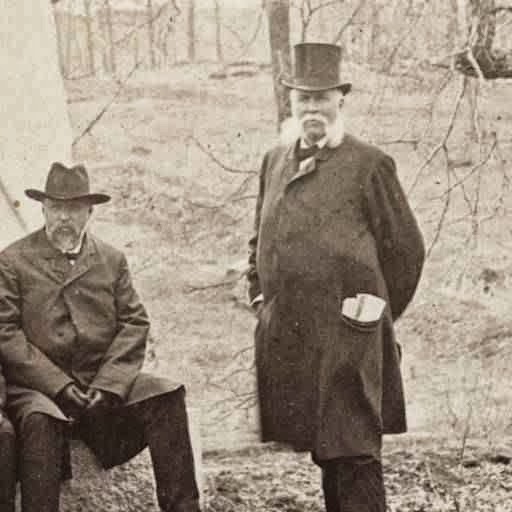
Veterans pose at the 25th anniversary of the battle of Gettysburg in 1888. In the front row are some of the major
figures of the battle. From left, Joshua Lawrence Chamberlain of the 20th Maine; Gen. Dan Butterfield, Meade's
chief of staff at the battle (but not for much longer); Confederate Gen. James Longstreet; Dan Sickles commander of
the 3rd Corps; and Gen. Joseph B. Carr, whose troops fought gallantly in the Peach Orchard on July 2, 1863.  
The Confederate survivors of Gettysburg who returned in 1888 for the 25th anniversary of the battle became objects of curiosity. They were few in number compared with the thousands of Union veterans who returned to Gettysburg by wagon or carriage or on foot.

The Yankees are “killing the Southerners with kindness,” the New York Times reported. All the Union men wanted in return were souvenirs. Virginian John E. Sonnet, for one, gave away every badge and ribbon on his uniform to Pennsylvania veterans gathered on Cemetery Hill.

One southerner in particular was the center of attention. This was James B. Longstreet, “Old Pete,” whose corps had attacked the Union left on July 2, 1863. Longstreet was on a lifelong mission to rescue his reputation in the South. He had been skeptical of the plan to invade Pennsylvania and critical of Pickett’s Charge. Worse from the perspective of many southerners, after the war he had often spoken of his objections to Robert E. Lee’s plans and actions.

From his arrival at Gettysburg on June 30, 1888, Longstreet seldom had a moment to himself. He was tall and white-haired with long side-whiskers. The military bearing with which he carried himself belied his frailty. At one point the men with him begged him to sit down, and Longstreet slumped into a chair with a sigh.

Shortly after checking into the Gettysburg Springs Hotel, Longstreet joined in conversation with three Union men – Gens. Lucius Fairchild and John C. Robinson and Gov. James A. Beaver of Pennsylvania. Fairchild had been colonel of the 2nd Wisconsin Infantry at Gettysburg and had lost his left arm from a wound on July 1, 1863. Robinson, a New Yorker and a division commander at Gettysburg, had later lost a leg at Spotsylvania. Beaver’s 148th Pennsylvania Infantry had fought without him in the Wheatfield in the brigade of Col. Edward E. Cross of New Hampshire. At the time Beaver was recovering from wounds suffered at Chancellorsville. Later he lost a leg at Cold Harbor. He got around on crutches.

Henry Ware Lawton was a 19-year-old captain
in the 30th Indiana when this photo was taken.
Fairchild had fought with the Iron Brigade in John Reynolds’s Grove. Monuments to these Wisconsin men were ready, and Longstreet joined Fairchild for their dedication. Near the memorials they chatted with an officer from an artillery brigade that Reynolds had once commanded. Longstreet also met Capt. Henry Ware Lawton, a Cavalry officer who, two years before, had led the expedition that captured Geronimo in Arizona.

During the dedication John C. Spooner, a Wisconsin senator, read his speech from pink slips of paper. The Milwaukee Daily Journal lauded his “glowing tribute,” but the New York Times reporter sniffed: “The matter was good, but would have given more satisfaction had there not been so much of it.” Fairchild followed with briefer and more personal remarks, moving the Wisconsin men to tears.

At 1 p.m., Longstreet met Dan Sickles, general of the 3rd Union Corps, which Longstreet had attacked on July 2, 1863. Like Longstreet, Sickles had a reputation to burnish. He had been criticized for, at best, willfully misreading his orders when he moved his corps forward on the afternoon of the battle. His line was too long and thin and disconnected from the rest of the Army of the Potomac. Only timely reconnaissance, reinforcements, fierce resistance and luck prevented Longstreet’s forces from crushing Sickles’s corps and gaining the Union rear.

Now the Union veterans wondered what would happen when the two foes met for the first time since the battle. Longstreet saw Sickles enter the dining room, stood and thrust out his right hand. Sickles grasped the hand, and Longstreet put his other arm around Sickles’s shoulder. They talked for half an hour.

A Union veteran in the crowd blurted out that the battle “might not have ended 25 years ago as it did, had your advice been taken once or twice.” Longstreet seized the opportunity: “It might have ended differently, Sah, if my advice had been taken on the first day or the third.” His questioner asked if Longstreet had opposed Pickett’s Charge. “Yes, Sah,” Longstreet answered.

He told the crowd he expected not more than 300 former Confederate soldiers would come to the reunion, but he did not think Gen. Jubal Early would be among them. Early, he said, might worry about the reception he would receive from the people of Chambersburg. After all, Early’s men had burned the place.

John F. Chase moved to St. Petersburg, Fla., after the war
and held several jobs. He promoted land sales in Gulfport,
then known as Veterans City. He died at 70 or 71 in 1914.
All eyes suddenly turned to a Union veteran standing nearby. His name was John F. Chase. He had been with the 5th Maine Artillery at Gettysburg, but his renown predated even his astonishing Gettysburg experience.

In Our War, I tell the story of Napoleon B.Perkins, a man from Chase’s artillery regiment who was badly wounded at Chancellorsville. Chase escaped the battlefield but later returned to the fray to carry his wounded lieutenant, Edmund Kirby, to safety. Kirby soon died, but not before recommending Chase for the Congressional Medal of Honor. On Feb. 7, 1888, just a few months before the Gettysburg reunion, Chase finally received his medal.

Most likely, what later happened at Gettysburg had bolstered Chase’s case for the medal. On July 3, his battery was firing on Confederate infantry from Cemetery Hill when an enemy shell struck near him. The explosion severed his right arm and destroyed his left eye, and shrapnel riddled his body. Two days later, he was piled onto the dead wagon, but the driver heard him moan and gave him water. He emerged from the hospital after several months and went home to Augusta.

At the reunion Chase handed out pamphlets to anyone who wanted one. On them was an engraving showing his upper body with the stump of his left arm and the 48 wounds he had suffered from shell fragments. A New York Times reporter asked if he thought he was the most wounded man of the war. Chase said he hoped so, as he wasn’t certain a man could endure more wounds and survive.

John B. Bachelder (right) knew every foot of the Gettysburg battlefield.
After dinner Longstreet rode across the battlefield with two New Hampshire men, former governor Frederick Smyth and Col. John B. Bachelder. Smyth had come to Gettysburg a few days after the battle to try to find and care for wounded men from his state. Bachelder, a native of Gilmanton, an artist and a mapmaker, had made a years-long study of Union positions at Gettysburg. He was also instrumental in the placement of monuments. Bachelder, the Times reported, “has spent so much time on the field that he naturally knows every foot of it.”

Bachelder had reserved time for a July 2 tour with Longstreet, but he raised his questions with the general during the June 30 drive with Smyth. One place the men stopped was the Bloody Angle at the stone that reads: “Brig.-Gen. Lewis A. Armistead, C.S.A., fell here, July 3, 1863.” This is known as the High-Water Mark of the Confederacy. On July 3, Armistead laid his hand on a Union cannon there and said, “Gentlemen, this gun is ours.” He was shot dead moments later.

On July 2, 1888, a Miss Sadie Creasey decorated Longstreet with a red rose and a miniature American flag. On the button of his frock coat hung a miniature canteen with Gen. Philip Sheridan’s bust on it. Longstreet drove with Union Gen. Henry Slocum to Culp’s Hill for the dedication of New York monuments, and the two toured the battlefield afterward.

Meanwhile, at the other end of the Union line, Sickles presided at the ceremonies for his old New York brigade only to have the platform buckle as he spoke. “It’s not easy to frighten what’s left of the Excelsior Brigade,” he said. He hoped more notice would be given if the platform again “proposed to find its level.”

The crux of his speech was a defense of his actions on July 2, and he had chosen a pliant audience to make his case. As always, he said that given a chance to relive that day, he would order the same advance. History, he said, would sustain his view that the 3rd Corps had borne the brunt of the battle on its truly decisive second day. The veterans cheered and shouted, “We know it!” Sickles told them: “I know you without uniform or sign. I know you by the grasp of your hand. I know by your faces that you love me as I love you.” Cheers erupted, and a Zouave drum corps “made the peach trees tremble” to the tune of “Rally Round the Flag.”

Sickles spoke again at the National Ceremony, the main venue of day. There he defined the war's meaning after a quarter century, but he first addressed the veterans of both armies.

“Now the combatants of 1863 come together again on your old field of battle, to unite in pledges of devotion to one Constitution, one Union, and one flag,” Sickles said. “To-day there are no victors, no vanquished. As Americans we may all claim a common share in the glories of this battlefield. . . .

John B. Gordon welcomed North-South reunion.
“The conflict of 1861-5 was a war of institutions and systems and policies. It was a revolution, ranking in importance with the French Revolution of the eighteenth century and with the English revolution of the seventeenth, universal in its beneficent influence upon the destinies of this country, and ineffaceable in the footprints it made in the path of our national progress. . . .

“And now that time and thought, common sense and common interest have softened all the animosities of war, we may bury them forever, while we cherish and perpetuate as Americans the immortal heritage of honor belonging to the Republic that became imperishable when it became free.

“The war of 1861-5 was our heroic age.”

Confederate Gen. John B. Gordon’s took up Sickles’s theme of bygones-be-bygones and applied it to the field where the veterans met. Despite the fierceness of the battle, he said, Gettysburg should now be “a Mecca for the North which so grandly defended it, a Mecca for the South which so bravely and persistently stormed it. We join you in setting apart this land as an enduring monument of peace, brotherhood and perpetual union.”

Monday, September 30, 2013

Robert Caro's relentless inquiry into power in public life

This past weekend I had a chance to listen to a man who has pursued the mystery of one defining American quality for nearly half a century: the essence of power and its use. His name is Robert A. Caro. Some of us have been following his journey since 1982, reading his thick books on the life of Lyndon B. Johnson – four so far – shortly after they roll off the presses.

Robert A. Caro's Johnson is a paradox of ruthlessness and compassion.   
I cannot wait for the fifth. A principal subject will be Lyndon Johnson and Vietnam. This story shaped my life. I have wondered since the 1960s whether the Vietnam War would have happened had John F. Kennedy not been assassinated, and I look forward to Caro’s take on the subject.

Caro was a Nieman Fellow at Harvard in 1965-66. There he hit upon the idea of writing a biography of Robert Moses, the urban planner known as the “master builder” of New York City during the mid-20th century. He had been a reporter at Newsday but left daily journalism and began digging.

In the seven years it took him to write The Power Broker, he had a year-long grant at Columbia but made little progress on the book. His wife Ida sold their house for money to live on, but they burned through the profit from that, too, and still no book.

At a gathering of Nieman Fellows last weekend in Cambridge, Caro was no longer the would-be author scraping by but the center of attention – a two-time Pulitzer winner among friends in awe of his success and eager to learn its secrets. But in fact he was the same man on the same mission.

He said he never thought of himself as writing a biography of Robert Moses. Rather his subject was power. How did an unelected public official acquire and use the power to shape New York City?

It is harder to deny that the LBJ project is a biography, but power remains Caro’s real subject. For nearly 40 years he has been exploring Johnson's grasp on power and use of it in the Senate and White House. (The vice presidency, as the most recent volume shows, frustrated Johnson to the point of humiliation, as even he could not wield power from that office.)

On Saturday, Caro was interviewed before an audience of hundreds of Nieman Fellows (interview video here) by Anne Hull, the reporter who exposed the shoddy treatment of wounded U.S. soldiers at Walter Reed Hospital. His answers laid out the two tracks of his method: archival research and interviews with people who knew and worked with Johnson, a much diminished breed.

When he began the project, Caro knew he could not examine all the millions upon millions of documents in the Johnson papers, but he decided to “turn every page” of the early congressional material.

A vital question was how Johnson had transformed himself from a pol who asked other pols, “Can I have a minute of your time?” to a pol whom other pols asked this question. A Texas bigwig had told Caro the answer – “Money, kid, money” – but had added that Caro would never figure out the details because Johnson had never put anything in writing about it.

Caro: LBJ "always wanted to help the poor." 
By turning every page, Caro not only pinpointed the time of this change to the fall of 1940 but also uncovered the cryptic system by which Johnson recorded who was giving him how much. He even figured out LBJ’s way of writing off those who disappointed him by not paying up. “You never crossed LBJ,” Caro said.

Caro traveled to the Texas Hill Country, LBJ’s home, and began asking people about him. “After a while I came to realize there was something they weren’t telling me,” he said. His solution was to move there. For three years, he and Ida lived at least 10 months out of the year in the Hill Country. When it dawned on people that he was not just another journalist parachuting in to do a profile of Johnson, they began to talk. Suddenly Caro was filling his notebooks with stories of Johnson's ruthlessness as a young man.

He also learned about life in the Hill Country, digging his own fingers into the soil and realizing how little of it there was. This was evidence of how slight the margin of error was for people trying to live off the land there, or, as he put it: “You can’t make a mistake here or you lose your house.”

To some degree it explains the paradox of LBJ. In Caro’s telling, he is a man of utter ruthlessness but also genuine compassion for the poor. In theory and in practice, Caro said, these characteristics are so extreme “that you keep thinking you are exaggerating. . . . Then ‘Wow! Look what he’s doing now.’ You’re in awe of the magnitude of it.”


Did Caro really believe that a moral imperative drove LBJ? Was his compassion for the underprivileged real or did he pursue the Great Society and other programs to further his own career?

“He always wanted to help the poor,” Caro answered, and he cited an example. As a young man, LBJ had spent a year as a teacher. His pupils were Mexican or Mexican-American, and he was diligent in teaching them to read. What’s more, he stayed late. Sitting beside the school’s janitor on the stairs as the man read to him, Johnson corrected his pronunciation.

Caro said that even though Congress faced obstacles in the 1950s similar to the deadlock of today, the difference is that no one today has the skills LBJ had. Part of true genius, he said, is “You find a way that no one has done before.” That was Johnson’s accomplishment: He found a way to make the system work.

Caro turns 78 years old next month. He is still learning things about Johnson every day. He has an office in New York where he reports, researches and writes. He puts on a coat and tie each workday to remind himself that he has a job to do, and he writes 1,000 words a day. “These are all tricks,” he says.

Caro never regretted the turn he took from newspaper reporting during the late 1960s. “As a reporter,” he said, “I just hated that you always had to write when you still had questions.”

He'll get to my question in the next volume. The power to make war is, of course, the greatest power a president has, and in the case of Vietnam, who better to get to the bottom of it than Caro? Vietnam was certainly Johnson's war, and we'll never really know what Kennedy would have done about the crisis there had he lived. The Johnson tapes show both LBJ's reluctance to get into a ground war and his early recognition that the war could not be won. This is the tragedy of the Johnson presidency, and it was an even greater tragedy for many who fought there.

I'm eager to see what Caro makes of it.

Thursday, September 26, 2013

'The monument is wholly unlike any other on the ground, and naturally attracts much attention'

Veterans and family members at the 5th New Hampshire monument dedication on July 2, 1886. Seated on the boulder with his feet on the ground is Elias T. Marston, the speaker that day. On July 2, 1863, he had been the 5th's 20-year-old adjutant. Next to him is Charles Hapgood, the 5th's lieutenant colonel, who had helped identify this as the spot where Col. Edward E. Cross was shot. Beside the monument opposite Marston is Gus Sanborn, a private from Franklin who rose to captain. At the far right is Sgt. John McCrillis, who painted the 5th's symbol, a large red trefoil, on his barn after the war. 
When the veteran soldiers of New Hampshire who had fought at Gettysburg gathered there again in 1886, it had been 23 years since the gore, fear, ferocity, near-defeat and ultimate triumph of that battle. They came together to walk the field and remember.

The Sharpshooter monument is made of Concord granite.
Veterans of the 2nd and the 5th New Hampshire volunteer infantry regiments and Companies F and G of Berdan's Sharpshooters dedicated their monuments on July 2, the anniversary of the day they had been in action. Companies F and G of Berdan's Sharpshooters, both recruited in New Hampshire, had fought on the Union left on July 2, 1863, but chose to place their monument at their third-day position on Cemetery Ridge.

The 12th New Hampshire Volunteers also fought on the second day, but their monument was not dedicated until September 1888. It bears lines from a poem by Dr. Oliver Wendell Holmes Sr., father of the future Supreme Court Justice. The inscription reads:


The 5th New Hampshire monument is in Rose’s Woods on the spot where Col. Edward E. Cross was mortally wounded. Lt. Col. Charles Hapgood, who was speaking with Cross when he was shot, helped identify the spot. He attended the dedication.

Congressman Haynes
The 2nd New Hampshire monument is on the southwest corner of the Peach Orchard just at the L-shaped angle where the 3rd Corps line turned east toward the Wheatfield and Little Roundtop and north along the Emmittsburg Road toward the town of Gettysburg. The speaker at its dedication was Congressman Martin Alonzo Haynes, who had been an articulate young rifleman in the 2nd in 1863.

In Our War, I tell the story of New Hampshire at Gettysburg through the experiences of Cross, Haynes and Richard W. Musgrove, who gave the dedicatory speech at the 12th’s monument.

On July 22, 1886, nearly three weeks after the veterans gathered in Gettysburg, the The National Tribune in Washington, D.C., published a detailed account of their return to the battlefield. Most likely, it was written by Haynes. Here it is:

The first Reunion of New Hampshire soldiers who participated in the battle of Gettysburg in July, 1863, took place in that historic town, in connection with that of the Third Corps, under circumstances of peculiar interest.

It will be remembered that at the last session of the Legislature an appropriation of $500 was made to each of the military organizations of the State which participated in that memorable battle upon Northern soil for the purpose of erecting a monument to mark the position of such organizations upon that battleground.

Private Haynes 
The New Hampshire contingent of participants in this Reunion and dedication of monuments left on June 29, and proceeded via the Fall River line of steamers and the Pennsylvania & Cumberland Valley Railroads, arriving at Gettysburg at 6 o’clock on the evening of the 30th. The party was soon quartered in hotels and private houses, mainly in the village, although some tarried in a house upon the Emmittsburg road, near the historic Peach Orchard, in order to be nearer the scene of their action of 23 years ago. 

Thursday, 1st, the 23d anniversary of the opening day of the battle of Gettysburg was spent in looking over the battlefield, and especially the portions occupied by the Union forces on the second day of the battle.

Of course 23 years have wrought many changes in the appearance of the battlefield, which covers so vast an extent of territory, and it was not to be wondered at that it required careful search and retracing of steps to fix the localities of events which made a deep impression upon tho boys in blue at that time. But this was done, and the positions of the 2nd and 5th N. H. and of the Sharpshooters, on the 2nd and 3rd of July, were traced in detail, even to the spots where comrades fell or prisoners were captured.

It can be said to the credit of the 2nd N.H. that the most advanced position in the line of battle on our left at the Peach Orchard on the 2d of July was occupied by it until forced back to escape being cut off by Gen. Barksdale [Brig. Gen. William Barksdale was mortally wounded during the devastating attack his Mississippi made on Union 3rd Corps units.] Altogether the day was most busily spent, and nightfall found the boys weary with their campaigning, but amply repaid for their day’s tramping over the line of battle of the second day of the Gettysburg fight.

Friday, the 2nd, being the anniversary of the fighting on the left, in which Gen. Sickles’ Third Corps was engaged, and sustained such heavy losses, it was decided that the monuments to the 2nd and 5th N. H. and Sharpshooters should be dedicated and turned over to the Gettysburg Battlefield Memorial Association on that day. Accordingly, at 8 o’clock a car was taken on the short line of railroad which runs from the village of Gettysburg to Little Round Top Park, and passes very near to the Sharpshooters’ monument, which is located but a few rods from what is known as “Hancock Station.”

This is a station in name only, there being no structure for passengers to wait in, but only two or three steps which rise from the track to the slight knoll where a board announces that Gen. Hancock was wounded, and to the small clump of bushes to which ho was carried. [Maj. Gen. Winfield Scott Hancock, one of the heroes of Gettysburg, led the 2nd Corps, which included the 5th New Hampshire.]

John C. Linehan
Maj. E. T. Rowell, of Lowell, Chairman of the Monument Committee, called upon Comrade Rev. C. H. Kimball to offer prayer, after which “America” was sung, and Maj. Rowell addressed Past Department Commander John C. Linehan, the New Hampshire Director of the Gettysburg Battlefield Memorial Association, tendering the monument, to which Col. Linehan responded in eloquent terms.

The 5th N. H. monument was also dedicated. This monument is located on the spot where Col. Cross fell mortally wounded, in the woods near the field in which Gen. Sickles was wounded.

The monument is wholly unlike any other on the ground, and naturally attracts much attention. It consists of a hammered disk of New Hampshire granite, upon which the names of the dead are inscribed, resting on large boulders, and also surmounted by a boulder.


Capt. J. R. McCrillis, Chairman of the Monument Committee, called upon Col. Hapgood to offer prayer, after which Adjutant Elias T. Marston delivered a fine address. Capt. McCrillis, in a short and appropriate address, turned the monument over to the Battlefield Memorial Association, and Col. John C. Linehan replied appropriately.

John W. Adams, the 2nd's former chaplain.
The 2nd N. H. monument was dedicated at 3 o’clock, the suspension of the rain serving to give an increased audience over the forenoon exercises. This monument is located on the advanced line in the Peach Orchard, which was occupied by the regiment on July 2, 1863, near tho old rail fence, and fronting upon an avenue that is to be laid out through the Peach Orchard. The Orchard, by the way, does not contain any of the trees that grew in it 23 years ago, but a lot of thrifty young trees. Gen. Patterson, Chairman of the Committee to procure the monument, called upon Chap. J. W. Adams to offer prayer, after which Congressman Martin A. Haynes spoke most eloquently. 
We give the concluding paragraphs:

“The 2nd had made its record at Gettysburg. The plain figures chiseled upon that block of granite are the eloquent record of the deed. One hundred and ninety-three men stricken not from a division, not from a brigade, but from one little skeleton regiment numbering but 355 officers and men.

“Do those who never stood in the battle line understand what such figures mean? Why, battles have been fought which were pivotal events in history and are quoted as monuments of valor, with less aggregate loss than that of the 2nd N. H. upon this spot. Our fathers won Bennington, and bravely won it, with a loss of but 70 killed and wounded. Trenton and Princeton combined cost Washington only about half the men that Gettysburg cost our single regiment. And Yorktown was won and American independence assured with less than half the loss to the American army that our regiment here sustained; while the total loss of our French allies fell seven below our figures, amounting to 180 men. “Tippecanoe” became the rallying cry of a great political party, upon which its hero was elevated to the Presidency; but Tippecanoe, stubborn fight that it was, cost Harrison’s army only 188 men. There is a world of suggestion in such figures as these. It was a veteran regiment that fought here, and it can be safely assumed that none but a veteran regiment could have stood such a test and done such a work.

“These were men who fought at Bull Run, who followed Hooker in the battles of the Peninsula, who charged with Grover over tho railroad bank at Groveton. But not all that stood with us at Gettysburg had such a record. The number in line at the Peach Orchard was probably less than the recruits which the regiment had from time to time received.

2nd New Hampshire monument in the Peach Orchard.
“Our brave old Col. Marston [Gilman Marston of Exeter also remained a congressman intil early 1863] wore the well-earned stars of a General, in another command, and he who had been the 10th Captain in the line had risen by regular promotion to the command of the regiment [Col. Edward L. Bailey of Manchester, 23 years old at the time, was wounded during the battle]. Such had been the changes incident to the service. But that the regiment was a veteran regiment by no mean carries the assumption that it was composed exclusively of veterans. In fact, there were in our ranks nearly a hundred men who here for the first time heard the roar of hostile guns, it was a rough initiation, but of all who fought here there were none braver or better than our raw recruits, the men of the dismantled 17th.

Such was the regiment – such was its deed. Our State has indicated its pride in both by setting here this memorial stone. We are not many, we who stood at Gettysburg. Some escaped the iron hail here only to meet their fate on other fields, and our number is rapidly growing less. For us the living, this monument stands as a memorial to our comrades, our brothers, who here gave up their lives. Our recompense while living is ample in the proud privilege of saying, ‘I was with the 2nd regiment at Gettysburg!’ And when we are all gone – and that day will not be long in coming – generations of New Hampshire men will point to the record there inscribed with an honest pride in the achievements of their ancestors who lived in an age which they will recognize as heroic.”

Edward L. Bailey, the 2nd's "boy colonel" at Gettysburg.
The address was followed by a poem by Chaplain Adams, and the reading of a letter from Col. Edward L. Bailey by Comrade Thomas B. Little. Gen. Patterson turned over the monument to the custody of the Battlefield Monument Association, to which Col. Linehan replied. Group pictures were taken of the three monuments by local artists, which will be in demand in the several organizations, as they were pronounced to be good ones.

The losses of the 2nd and 5th regiments in killed, wounded and missing on July 2 were very heavy, and an inspection of the monuments already erected upon the field does not reveal any so heavy. The roll-call of the 2nd when it went into tho Peach Orchard was 24 officers and 330 men. At the close of the day 19 had been shot dead, 13 were wounded, and 38 missing. All of the field officers were wounded. Among the killed were Capt. Metcalf and Lieut. Roberts. Lieuts. Ballard, Dascomb, Vickery and Patch and Capt. Hubbard died of their wounds in a few days. The 5th went in with 21 officers and 165 men, of which number four officers and 82 men were killed and wounded.

[My thanks to Dave Morin and Andrew Harris for material that helped me prepare this post.]