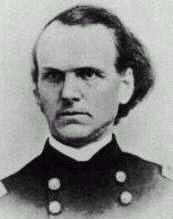
Saturday, September 14, 2013

Capt. Sturtevant: 'Before this rebellion is crushed out I fear a great many more of us will be in the sacred soil.'

Edward E. Sturtevant
Edward E. Sturtevant, a Concord police constable, joined the 1st New Hampshire Infantry in April 1861, becoming the state's first volunteer for the Civil War. In the days after the firing on Fort Sumter, he recruited more than 200 men for service. His regiment went to Washington and returned after its three-month term of enlistment without having fought a battle.

When Sturtevant reached Concord, the 5th New Hampshire Volunteers were forming. He joined as a captain of Company A, the Merrimack County company, and went to war under Col. Edward E. Cross, the fiery commander from Lancaster.

Most of the people I write about in Our War appear in only one chapter, but a few make multiple appearances. Sturtevant is one of these. That is because so many letters by and about him survive and are available to historians.

Some of his letters are well hidden. John Kimball, Concord’s marshal and a colleague of Sturtevant's, apparently agreed to look after his friend’s affairs at home while he was serving in the Fifth. Sturtevant wrote him regularly. These letters are now in the regimental files of Augustus Ayling at the New Hampshire State Archives. Ayling was a state adjutant general who compiled a register of New Hampshire soldiers after the war.

These Sturtevant letters give a strong sense of the local camaraderie that made life in the army more pleasant, and death more personal, during the early years of the war.

After the 5th New Hampshire’s first battle, at Fair Oaks, Va., on June 1, 1862, the regiment remained in place near the battlefield. Sturtevant wrote the following letter 22 days after the battle. He was now 35 years old, more than twice his age when he wrote the letter in the previous post. A few days after writing this letter, Sturtevant led the 5th in the Battle of Malvern Hill on the Virginia peninsula. He was also soon to receive the promotion to major that he refers to near the end of the letter. 

                                                                        Fair Oaks, Virginia
                                                                                    June 23rd, 1862
Friend Kimball –

Received your letter of 16th inst. a few days since and was glad to hear from you. Of course you have heard of the battle of Fair Oaks in which our Reg’t were engaged on the 1st of June. You probably have seen many persons who were engaged in that battle before this time, and have heard from some of them the part our Reg’t took on that occasion. If you have seen any who were here, they undoubtedly have told you much more than I could write.

It was a hard struggle – our chance was a hard one – and I think we done our part well. We had one of the hardest positions in the fight and have been complimented for the bravery and determined part we took in the battle by Generals high in rank.

Since the battle we have been in the front rank where we still remain – only about 500 yards from the rebel pickets – we have constant alarms – have to keep our harness on day and night, and “fall in” to receive the rebels should they be so insane as to attack us (which they occasionally do but are as often repulsed) in our own position.

We are now and have been since the battle “bivouacked” near the battle field. We are within some 5 or 6 miles of Richmond, which place we can see by getting up in tops of tall trees. We have to go on picket duty about twice a week. That is rather dangerous business, and frequently results in having some one or more killed and wounded.

An unfortunate occurance took place only last Wednesday night while my company were out on picket. Just as we had got out on post and relieved the company who were on the last 24 hours, rapid musket firing took place on our right with the pickets. The rebels were advancing and endeavoring to drive them in. Our lines in the camp were drawn up and grape and shells were used to drive them back. One shell, having a premature explosion, burst where my men were posted and injured one or more men.

We could not get in without receiving the full fire of our five cannons, so we remained, hugging the ground as close as we could. Soon grape and canister fell like rain all about us – tearing up the ground and cutting down trees, &c. After some five minutes a halt was made in the firing when I succeeded in getting word to our gunners that they were killing all my men and that no rebels were in front of my pickets.

I then went to my picket posts – to find who was injured – the first man was Wm H.H. Hayes, one of my best men, was the first one I saw – he had grape shot through his thigh – and yesterday we buried him. He belonged in Milton. I also learned that some others of my men had taken in S.S. Lovejoy of Concord severely wounded – having the flesh torn up the whole length of his back by a shell. I saw him afterward. He was badly though I think not dangerously injured. He has now been removed to White House Point, from whence he will go North to some hospital or perhaps home. Chas. H. Willard of Concord (Sand Hill) had a narrow escape, but was injured only slightly in the back and shoulder, and James H. Ferrin of Warner received a slight injury. . . . George Morse of Co. F (of Concord) who was inside our entrenchments received a wound in neck from a piece of tin in which the canister shot were enclosed. The last three are not serious wounds. But the loss to the rebels was immense, as was reported, several hundred wounded and killed.

Almost every day the rebels make some attack on our lines. Saturday night last a whole division of them attempted to break through and take some of our works but they were immediately repulsed with great loss. We lost two or three in killed and wounded. This happened in front of our Division and Hooker’s. All hands of us were kept up all night and picket firing was constantly going on.

From prisoners taken at the time we learn the same old story that “the rebels are short of provisions,” that this attack was made to take our commissary stores away from us, as they (the rebels) had that morning two days’ rations given out that the next rations they got they must take from us. The effort of the rebels failed and if the deserters can be relied on, they must be very short of rations.

We were in line, waiting rather impatiently for them to come on all Saturday night and Sunday, but they have been very quiet and we cannot hardly hear any noise from them since their effort last Saturday up to this time (Monday morning 6 o’clock.) Every morning a ½ past two we are in line of battle until after 6 o’clock, and don’t mean they shall catch us “napping.”

Lt. Albert G. Cummings
Often of late they have kept up a continual “drumming” all night and most of the time during the day. Our army do not allow any music of any kind, so the rebels are deceived of where all our forces lie. We have had quite a number of reinforcements arrive recently. We have many sick especially in our Reg’t – Diarhea and “general debility” prevail to a great extent in the Reg’t. I have now present for duty only about 40 men – I am alone with my company – Cummings [1st Lt. Albert G. Cummings of Enfield], home wounded – Larkin [1st Lt. James E. Larkin of Concord], sick and will probably go to Philadelphia or some other city for repairs in hospital to-day or to-morrow. I have now absent sick including the wounded some 25 or 30 men. Other companies in the Reg’t are in about the same condition.

All of the severely wounded I have yet heard from in my company were in Philadelphia, where they write me they are receiving excellent attention. I receive many letters as to the condition of those wounded in my company charging me to look especially after them, &c.  I cannot do nothing for the wounded, except those who remain, (and those are the ones only slightly wounded,) with the company, as all of them were taken from here and transported to some of the hospitals in Philadelphia, Baltimore, or New York where after their arrival they or someone else notifies me of their arrival. All I have now heard from were in Philadelphia, but in different hospitals.

The dead from my company I burried or rather had burried in separate graves and placed over the head of the grave a slab on which was marked their name and company. This was all I could do – and it was a sad duty to perform. I have lost my best men. They fought bravely and died for a worthy cause, and before this rebellion is crushed out I fear a great many more of us will be in the “sacred soil.” But we enlisted for the war, and therefore must take its chances.

I am pretty tough myself now – my shoulder is about as well as ever. We have not yet been paid off, expect to be soon. The 2nd Reg’t is only a short distance from here. I see some of them nearly every day – have just had a call from John Cooper and Bill Wallace. I see Maj. Stevens (or rather Lt. Col.) [Josiah Stevens, a Newport native, lived in Concord and was a friend of Sturtevant’s] has got back, but have not seen him to have any talk with him yet.

I saw several big cannon have just arrived and we shall soon be putting them in position, so I infer that Gen McClellan has adopted your suggestion in regard to the “big guns.” It would not be strange for me to have a fight at almost any time, but I think it will be a few weeks at least before the battle if the rebels do not attack us, in which case of course we must fight whether we have “big guns” or not.

In case you hear of their being a chance of any promotion within this regiment I think I have as good a claim for it as any body else, and shall claim it, but their probably will be none at present – the Col. and Maj. are both home wounded now. I wish you would “pull a string for me” if there is any chance. The reason I speak of this is there are some ambitious ones who are very anxious for promotion who I should not wish to have rank me without sufficient cause – just because they happen to have had better advantages than I have had for an education – I think and will try to do my fighting just as well as they do, which I think I can do now and have already done.

Perhaps I am chasing a phantom and no one is anxious, but I thought it might be well enough to look out for myself once if there was a chance. Keep this to yourself.

I have many letters, descriptive lists, finals statements &c to make out today. I shall send you some money when paid off. We hear nothing as yet of our missing men. I wish you would express my thanks to Chas Savoy when you see him for that box of Sardines he sent me by Maj. Stevens. I had them for my Sunday dinner yesterday.

Remember me to all the boys at the office. Accept my best wishes for yourself and write when convenient. Excuse this badly composed letter as camp is no enviable place to write in.

                                                            Respectfully &c
                                                            E.E. Sturtevant


Our reg’t is now commanded by Lt. Col. Langley – he was sick the other day and I had command during the time, as I am the ranking Captain. Our Brig. Gen.s name now is Caldwell. We are in Richardson’s Division.

Wednesday, September 11, 2013

The yeasty early years of Edward E. Sturtevant

The place was wall-to-wall dealers of Civil War relics: muskets, banners, canteens, uniform coats, dog-tags, buttons, letters, photographs. There were more than 100 tables, and before the day was through, I had visited most of them.

My mission was narrow. I was looking for material about the 5th New Hampshire Volunteers. Mark Travis and I were researching a book on this storied regiment, and I hoped to find letters and photos of soldiers who had fought in it.

Mostly the dealers shook their heads. One or two had CDVs of 5th soldiers, the little photographs the men had made of themselves in the 1860s. To a father of three only halfway through the college tuition tunnel, the prices were too high.

Then I came to a table where the dealer had stacks and stacks of soldier letters. “Any 5th New Hampshire letters?” I asked. He thought a moment and said no. As I started to move on, he said, “Wait just a second.” He turned to the large stock behind him and pulled out a pile of letters. They were prewar letters, he said, but he thought the writer might have been in the 5th.

A New Hampshire encampment of the Grand Army
 of Republic, the leading Civil War veterans'
association, was named after Edward E. Sturtevant.
One of the many rumors Mark Travis and I had heard during our hunt for material was that somewhere out there was a trunk containing the papers of Edward E. Sturtevant, who became the 5th’s major. Such rumors torment any researcher. They seldom pan out, but that doesn’t mean they aren’t true.

Well, sure enough, here at this show, which was in a convention center at Gettysburg, I beheld before me a large stack of Sturtevant’s letters. True, they were not wartime letters, but they gave a detailed picture of Sturtevant’s times and thoughts during the 18 years leading up to the war.

I swallowed hard and asked the price. There were nearly 80 letters, some of them six or eight pages long. A few mentioned presidents and other famous Americans, and these generally had price tags in the hundreds of dollars. The dealer removed these – there were about half a dozen – and told me I could have the rest for $10 each. Tuition or no tuition, I couldn’t say no.

The removed letters, including one in which the 23-year-old Sturtevant purposely stepped on the backs of women’s dresses at a White House reception, went to the four winds. The dealer said he would send me copies of them but never did.

I don’t dwell on what I didn’t get because what I did get was wonderful. It allowed Travis and me to flesh Sturtevant out as a character in My Brave Boys, our history of the Fifth. Twelve years later. the letters brought Sturtevant to life in the first chapter of Our War. He was New Hampshire’s first Civil War volunteer and as such represented the wild enthusiasm for saving the Union that burst forth in the North after the Confederates fired on Fort Sumter.

Sturtevant was born in Keene, N.H., on Aug. 7, 1826, to George and Fanny Sturtevant. At the age of 16, he moved to Concord as a printer’s apprentice. He worked as a printer in Concord and Richmond, Va., until the mid-1850s, when he became a Concord police constable.

His letters to his family in Keene describe his life in vivid detail. I thought I’d share an excerpt from one letter and most of a second one with you today. A wartime letter will be the subject of a future post.

Sturetvant wrote both of today’s letters in early 1844, when he was 17 years old. This excerpt from his Jan. 27 letter is about the enforcement of a temperance ordinance passed by Concord at town meeting (New Hampshire’s capital did not become a city till 1853). Three of the men mentioned in it were civic leaders of the time: General Joseph Low, Dudley Palmer and Franklin Pierce, the future president:

A fervent prohibition enforcer during the 1840s. Franklin
Pierce later exhibited a weakness for alcohol himself. 
“Temperance is progressing very rapidly here at the present time. Low is doing the work up in good shape. Prosecutions are taking place every day or two. On the first day of January, all dealers in intoxicating Drinks were forbid to sell any more, by prosecuting committee, consisting of Gen. Low, Frank Pierce, Dud. Palmer, and eight other of the leading men of this town.

“Blake, seller keeper, was arrested for selling Rum, tried and convicted, but was so stuffy that he would not give bonds, and consequently was carried to Hopkinton Jail, where he stayed one or two days, but got sick of the fun and excepted bonds.

“It would take a great while to name all the instances, where they have refused to obey the law, so I will only name one or two of the principal ones. Nearly all that have sold since the 1st day of January have been arrested. Not a drop can be procured for any purpose whatever – sickness or anything else.

“In one instance, when the sheriff went to arrest one of these vile grog sellers, the keeper of the rum hole and the rum-soakers fastened the door and armed themselves with clubs, and swore that the first man that opened the door they would split his brains out – but the sheriff waited about two hours and then took an axe and split the door open, and arrested him. The rum drinkers and keeper of the rum hole were all scared half to death, and all of them were full of excuses. The keeper was taken, tried, and convicted on two indictments on which he gave bonds.

“Dud. Palmer was knocked down by a man named Wm. Daymen, at his house, about nine o’clock the same night. Daymen went up to Palmer’s house, knocked on the door, Palmer came to the door and a few words passed between them after which Daymen struck Palmer and hit him, but did not knock him down. P. took the broomstick and struck D. in the face with it. The next day P. was walking down street between Gay’s hotel and Hill’s building when D. was going up street with a horse sled and D. stopped his team and got off and went up to P., a few words passed between them, D. struck at P. but did not hit him and fell down on his face, and P. threw himself down upon him but the people sepperated them before either was hurt. P. took D. up the same night, which was a week ago yesterday, and he was tried and convicted.”

---

And here is Sturtevant’s letter to his family on March 16, 1844, a Sunday. It shows both the youthful energy and enthusiasm of the man and the reformist excitements of the time during which he came of age.

Dear Friends:

I was very glad to receive your letter, and I suppose you have been expecting to hear from me for sometime. It having been a very busy time since I received your letter is the reason that I have not answered it. . . .

I have purchased me a pair of boots, but no coat, as yet, but I intend to in a few days, as my quarter is out in a day or two. My old coat holds out like the tooth ache, and looks very well considering its age. I intend to buy a black broadcloth frock coat in a few days. My other clothes are all in good repair.

I was under the necessity of putting on my new pantaloons only in the winter, as my old ones gave way, and my new ones was so much the warmest that I was afraid I should take cold if I shifted them too often. The old pants will do to wear a while in warmer weather. . . .

I have attended meeting several times at several different places. A few Sundays ago I attended meeting at the State’s Prison. The prisoners look neat and tidy. They have a “base viol,” which is played on by one of the prisoners, and several singers, all of which are prisoners. It sounds like the Methodist singing. Rev. John Atwood, chaplain, preached an appropriate sermon.

As I entered the guard room the first man I met was Mr. Willard Clarke of your town. I learnt from him what the “news” was, and how the folks did. I perceive that the “Keene Light Infantry” held a military ball, of which I knew nothing till I accidentally saw it noticed in the Cheshire Republican, and in your last letter. . . .

I attended, a few weeks since, the exhibition of the “Concord Literary Institution and Teachers Seminary,” under the superintendance of Mr. A. Day, jr., which was a very good one, but not equal to the one I attended, in Swanzey, when I was at home. He has the name of being a very excellent teacher – the best that has been in the institution for some time. Hon. Josiah Stevens, jr., late Secretary of State, has a school and is highly esteemed by all and pronounced as a very successful teacher.

William Miller, millennialist preacher
The Millerites [followers of William Miller, who had predicted that Christ would come again in 1843 or 1844] are in abundance here at the present time but I don’t expect they are going to be here much longer if their sayings prove true. They have bought them an old Carpenter’s shop, and hold meeting every Sunday evening – a few Sunday evenings ago I attended, and to help laughing was like trying to help dying – I had been there a few minutes when a man came up behind me and put his hand on my head and said that “God was coming, and the Devil too!!” This created some laughter, and in a little while afterwards another man got up and said that “it made God sick to the stomach to see a luke-warm professor!!!” – and the whole proceedings of the meeting were like the above – and because some few – not a very few – laughed, they were arrested, tried and convicted!

The justice was the Clerk of the Court of Common Please, Judge Badger, a great deal more of a jackass than old Elijah Parker. One person, by the name of Brown, was arrested and convicted on the following evidence: – A person by the name of Bill Wallace, swore that he spit on a man and perhaps on a woman!! This charge Brown did not deny only by saying he did not do it as he knew of but it might be possible that he did, and it might be possible that he did not, as the people crowded in to the house in a jam so thick that you could not hardly breathe. He was fined one dollar and cost, which cost him about seven dollars. This was the evidence one was convicted on. Two others were convicted on similar evidence. And I and about a dozen more were only threatened! I have no room to say any more on this subject – but I have not been near them since, nor do I ever intend to again!

In justice to the millerites I would say it was not the millerites that went in for prosecuting, but a few diabolical loafers, who thought they could make some thing by so doing!!!

Stephen Symonds Foster, the New
Hampshire-born reformer 
John A. Collins, who preaches up reform, and a very eloquent man, has been here and held meetings and I have attended several of them, and have been highly gratified. S.S. Foster was also here at the same time [Stephen Symonds Foster was a radical abolitionist, women’s rights advocate and temperance supporter born in Canterbury, N.H., in 1809]. He lectured on slavery, and denounced, in the bitterest terms, Martin Van Buren and Henry Clay. He says Martin Van Buren is the meanest man that ever draged his body across the American contenant, and Henry Clay is the vilest reptile that ever walked across the American contenant! I wish you could here him and Collins, they are amusing speakers, eloquent, witty, and interesting.

A few nights ago Engine No. 4, was got out to drown out a seller full of drunkards, but they, the drunkards, got wind of the game and cleared out. The Engine was stationed near a well of water, and the sucsion hose put into the well, where they had water enough to drowned out the whole town if they wanted it. The folks then began to work the breaks, and instantly the whole of the glass in the door was smashed out, but after working the engine awhile, and pouring in a large quantity of water they found out that the drunkards had all fled, and they had to put up their engine and go home without wetting the drunkards and keepers of the seller, but their was one consolation for the people and that was driving the drunkards home from this den of iniquity!!!

The cellar was kept by one man named Lesley, where there was a dozen or more drunkards congregated. A gang of young fellows thought they would give them a ducking and accordingly made preparation to do so about nine o’clk., in the evening. Every square of glass was broke out by the water thrown from the hose of the engine. Nothing yet has been done for prosecuting any of the persons engaged in this riotous act – and probably will not be.

I was at the fire at the State Prison and stationed myself on the roof of one of the shops a part of the time. I was also at the fire of South Boscawen (Fisherville) and went up with engine No. 2, and stayed till it was got under. There was never a set of men that worked better than did those that were there. The factory girls as well as the men helped work the engines when the men were tired. The factory was as much in flames as was Faulkner Colby’s mill, of your town, some years ago, when the engines reached the place, but the untiring efforts of the firemen, factory girls and people saved it from entire consumation.

Town Meeting came off here on Tuesday. The whole day was spent in an attempt to choose a moderator. The second day was spent in the same way. But on the third day the Whigs and Conservatives and Abolitionists united on one man, and elected him on the first ballot. Nothing but row! was the order of the day.

The Constables, and sheriffs were ordered to quell the riot, but instead of effecting any great good they made the matter worse. The constables arrested one fellow and the rowdies and others made a crowd and liberated him. I have not room to name all the instances in which all the constables and sheriffs were imposed upon by the rowdies. . . .

I write this in great haste and you must make allowance for mistake. It has been a long time since you wrote me and I feel anxious to her from you. . . .

E.E. Sturtevant

Monday, September 9, 2013

Curses to 'Old Abe and His gang of cutthroats'

I love old New England cemeteries, especially those hidden away on back roads.

Over the Labor Day weekend Monique and I took four of our grandkids to visit an alpaca farm in Elkins, a village in New London, N.H. It was the greatest thing: 90 alpacas with names like Norwegian Wood, Ginger Ale and Phantom of the Opera, big hairy angora rabbits, and funky chickens, including one with an Afro that would have done Jimi Hendrix proud. Sue King, who raises these animals with her husband, graciously led the six of us on a tour of the place. The kids loved it. 

A few of the alpacas of Elkins, N.H. 
After leaving the farm, we weren’t five seconds beyond an old cemetery when I suggested we turn around and search it for Civil War graves.

Grace, our oldest granddaughter, groaned. She had been down this road before. Our second oldest granddaughter, Eleanor, said she was afraid of cemeteries. But soon we were all wandering the spongy grass of the Elkins Cemetery looking for graves marked by American flags and GAR emblems.

New London was a town of 950 people in 1862 when 38 members of McCutchins Guards, the town militia, volunteered together to serve in the war. One of them, a fifer name Ransom Sargent, is the central character in the last chapter of Our War. With his militia comrades he joined Company F of the 11th New Hampshire Volunteers. This regiment went to war in the fall of 1862 and served till June 1865.

Sargent is buried in the Old Main Street Cemetery in New London. In the Elkins Cemetery, we and our grandchildren found two of his comrades. They were:

Private Newton C. Everett, who was 25 when he joined Company F. He was wounded in the regiment’s first battle, at Fredericksburg, and discharged the following August. He lived to be 75.

Corporal George R. McFarland, the first man from New London to enlist. He had served in the three-month 1st New Hampshire before joined Company F a year after the 1st came home. Wounded in the Wilderness on May 6, 1864, he was discharged the following May. He died at 77.

Four of our grandchildren, Eleanor and Henry (front) and Grace and
Jackson, on the town common in Newport, N.H. The town's
Civil War memorial stands directly behind them.
It was our younger grandson, Henry, who made the most interesting find of the day. This was a tall, ornate Victorian stone with the name “Goings” on it. Buried there was Claude Goings, whose letters I first encountered in New Hampshire Fights the Civil War, Mather Cleveland’s 1969 book. 

Cleveland, a New London physician, was a scholar of the state’s Civil War experience. He collected many letters of New Hampshire soldiers, and eventually transcripts of these letters wound up in the Rauner collection at Dartmouth College.

In his book Cleveland used the letters of Claude and Charles Goings in his chapter on the 8th New Hampshire Volunteers. I read the letters at Rauner and quoted both brothers in my Our War chapter on soldiers’ racial attitudes at the time the Emancipation Proclamation took effect.

Claude Goings was a thorough racist – one of tens of thousands of soldiers with such views in the Union army. 

A carriage painter by trade and a violinist by avocation, Goings enlisted in late 1861 with his younger brothers, Charles and Austin, in the same company of the 8th. The brothers were both privates, but Claude went in as a 25-year-old corporal. The regiment served in Louisiana.

In early 1864 the 8th switched to horseback. The men were issued sabers, breech-loading carbines and Remington revolvers. After two months’ training, they became the 2nd New Hampshire Cavalry.

Claude Goings's gravestone.
Claude Goings was wounded at Bayou de la Glaize during the Red River campaign in May 1864.

He survived his wound and, his three-year enlistment up, left the army on Jan. 18, 1865. His brother Charles mustered out the same day. Austin had been discharged in 1862, probably because of illness.

In my chapter on the Emancipation Proclamation, I quoted letters from Louisiana from both Charles and Claude to Claude’s wife, Mary Pike Goings. Both mentioned their many encounters with African-Americans in Louisiana. Charles once wrote: “If I thought we were fighting to free them, I would throw my musket to the devil and leave. If I got my neck stretched, all wright.”

In January 1863, the month the proclamation took effect, Claude wrote Mary from Baton Rouge to express his disgust with the document. The recent Union defeat at Fredericksburg was also on his mind.

“The Soldiers Here are getting out of patience with Old Abe and His gang of cutthroats and their Hellish Scheme of Emancipation and mismanagement of our Armies,” Goings wrote. “What a scene must have been the Battlefield of Fredericksburg. . . . God have Mercy upon us all.

Claude Goings served in the 8th N.H. Volunteers.
“Our Rulers . . . are ready to Sacrefice us all in their attempt to Free the Nigger. Could I have foreseen Lincolns policy before I enlisted, it would have required force to have got me to Shoulder a musket or in any way contribute to Such a cause.”

Later he boiled his anger down to one sentence: “The ruling power thinks of nothing but the Poor Nigger!”

Standing before Claude Goings’s grave with my grandchildren, I decided they were too young for a lesson in the racial issues of the Civil War. Later, I hope.

Despite his harsh opinions Goings risked his life for his country. I respect that. Besides, I gave up the illusion long ago that most New England soldiers favored abolition and cared deeply about the plight of the slaves.

Had I lived 150 years ago, I hope my views would have been more enlightened than Claude Goings’s, but who really knows?

Saturday, September 7, 2013

From Fredericksburg to The Crater till the war's end, Private Don E. Scott believed God was by his side

During a recent interview for The Daily Beast, Marc Wortman asked the Civil War historian James M. McPherson what stood out from his reading of thousands and thousands of letters written by soldiers. McPherson answered:

Private Don E Scott (Photo courtesy
of Anthony Mincu. Thanks!)
“The patriotic and ideological convictions of so many soldiers, which kept them in the ranks and fighting for two, three, four years despite their homesickness and fears of the consequences of death or wounds for themselves and their families. I was also struck by the religiosity of many soldiers.”

This mirrors my own reading of soldier letters. But like many other students of the war, I am far more interested in the soldiers' political views and battle experiences than in their religiosity. Perhaps this reflects the skeptical, secular age we live in.

I was reminded of this divide as I read the letters of Don E. Scott, a soldier from Warner, N.H. The letters are at the University of North Carolina, which has posted them online, and my friend David Morin transcribed them.

Scott’s father died when he was young, and his mother, Hannah, married Daniel Warren, a Congregationalist pastor, in 1856. Warren was called to a pulpit in Warner the following year, and Don moved there with the family. He was 13 years old.

At the age of 18, Scott volunteered to go to war. He had been a student at Kimball Union Academy in Meriden and joined the 9th New Hampshire Volunteers in the summer of 1862. He transferred to the 11th New Hampshire before the regiment left Concord. Although the letters do not explain the transfer, it is possible he preferred the 11th because its ranks included many men from Warner and the nearby towns of Henniker, Sutton and New London.

Maj. Gen. Ambrose E. Burnside led
the 9th Corps, which included the 11th
New Hampshire during much of
Don E. Scott's service.
Scott fought with the 11th at Fredericksburg on Dec. 13, 1862, and during the siege of Vicksburg in the summer of 1863. The following spring, with the 6th and 9th New Hampshire in the New England brigade of Maj. Gen. Ambrose Burnside’s 9th Corps, the 11th fought in the Wilderness and participated in the siege of Petersburg. Scott wrote a stirring account of the Battle of the Crater on July 30, 1864, in which he participated.

Scott’s religious beliefs appear to predate his mother’s marriage to the pastor. In his letters from the front, written mostly to his mother, he almost never mentioned his stepfather. He also wrote little about why he was fighting. He felt persecuted for his open expressions of godliness, and he tended to judge others by his perceptions of their faith.    

The Scott letters begin in Concord just before the 11th New Hampshire left for the South. “I have opportunity to come home but will not for I have already bidden the good people of Warner goodbye and don’t care to see them till I come home from the war a timeworn and honored patriot,” he wrote.

Moses N. Collins, the 11th’s major, hired Scott as a butler but soon sent him back to the ranks. Scott assured his mother that Collins found no fault in him but also complained that the major and others had ridiculed him for his Christian practices.

“My time is now my own & I am free to go where I please within the limits of the camp,” he wrote. “I can read, can write, can go by myself in the woods or elsewhere and pray. I can be gone an hour or two without thinking all the time what the major will want. I can now read my testament without fear of being ridiculed. I think I have written you before that instead of finding the major a Christian I very often have heard him make light of religion & religious persons & often I have been the object of his derision & the mark at which he aimed his shafts.”

Scott believed losing the butler’s job was God’s will. “I am removed from evil influence which bore upon my morals, [and] it is a kind Providence that removed me. . . . I feel confident it is for the best that God’s hand is in it, & that He would protect my defenseless head in every time of danger and he will also preserve my faith when open to exposures upon guard duty. . . . I shall patiently endure all things trusting in God, & knowing that he loves & cares for his children.”

After the battle of Fredericksburg, Scott penciled his mother a note that he was all right, then wrote her again on Dec. 21, eight days after the battle:

“It is the Sabbath but nothing has transpired to remind me of its sacredness. No familiar ringing of church bells reaches my ears – no tinkling of sleigh bells . . . as they warn the wayside churchman of the encroaching hour of worship. . . . Not even a prayer have I heard offered on this Holy day save from my own lips. You must be assured that it is trying to the Christian soul to be thus deprived of all religious advantages.”

During the battle Scott had somehow become separated from his regiment, a common occurrence for Union forces at Fredericksburg. The 11th New Hampshire marched up under artillery fire and halted for a half hour before hearing the order, “Forward, 11th.” Cannon fire slowed the charge, and “the infantry, protected by their rifle pits, poured in a murderous fire upon our advancing column,” Scott wrote.

“Everything was in uproar and confusion. The booming of cannon, the bursting of shell, the roar of musketry, the groans and cries of the wounded and dying, the wild cries of officers encouraging their men forward & the cheering of the men as they rushed upon the foe all combined to make a scene that is highly exciting to say the least. . . . God grant that I may never witness the like again.”

Because he “lost” his regiment, Scott worried that he might have been reported missing, causing his mother to worry. “I could tell you of my many hair breadth escapes but it will do no good & I am only grateful, more so than I can express, for the safe deliverance from the dangers of the battlefield. My courage is still good & in God I place my trust.”

Indeed both his mother and sister wrote to him to express concern. He responded that his mother’s letter was “fraught with the deepest anxiety for the welfare of a son which she had no means of knowing was alive or dead.” He found in her words love, comfort and cheer that only a mother could offer.

A few weeks later, in early January 1863, Scott’s tent-mate, Private William Wadsworth of Henniker, died of disease. “I’ve been acquainted with him since I first went to Henniker to school,” wrote Scott. “He was not I believe a professing Christian. Poor fellow! I hope he was prepared for his final charge.”

Five members of Scott’s company were now gone. “God only knows whose turn it will be next,” he wrote. “It is not impossible that before these lines meet the eye of the intended reader, the hand which is now penciling this may be cold and stiff. . . . Although God I believe in his infinite love and mercy will spare my life & enable me to return at some not very distant day to my home & friends; yet the fortunes of war are so changing & life is so uncertain, I dare not attempt to tell what a day may bring forth.”

He believed God cared for him “not for any worthiness of my own but for Jesus’s sake He loves me, loves me with such a love as mortals never feel. . . . If death seizes me for its victim, I cannot wish for life, for God thus wills it.”

By late January 1863, Scott had two new tent-mates, Privates William G. Harriman and George Clark, both of Henniker. He judged them on the basis of belief and behavior.  “One is a moral fellow & the other I’m afraid to say is profane and ungodly,” he wrote. “His mother is a Christian & would blush to hear her son thus profane. I may do him good.”

He missed church. “O God only knows how I long to enjoy even one Sabbath in the house of God, to attend unmolested the house of prayer,” he wrote.  “. . . But although I am deprived of frequent religious meetings & society, yet no man can deprive me of the privilege of communing in secret with my God.”

He found pleasure in his Bible. “Every night the last thing before lying down I take out my testament & read a chapter & before closing the book look at your likeness which I carry in it & giving it one long press with my lips return it to its place. How many times I have done this, & wished I could embrace the original you can never know.”

Like Scott, Walter Harriman, colonel of the 11th
New Hampshire, was from Warner. 
In late February Scott had a visit with Almira Harriman, wife of Walter Harriman, colonel of the 11th New Hampshire. The Harrimans were from Warner, and Almira had brought a message from his mother. His return message was a kiss.

“The kiss I gave her was the first civilized act I have done since I came into the army, or so it seems,” he wrote. “It seemed so good to kiss a woman that I did not get over the effects of it for a good while. I am highly pleased with your opinion of a soldier, a true soldier. I think as you say, there is no one deserving the name of a soldier but he who bears a gun, & enters the battlefield & does not shrink when danger is nigh. . . . I love to think of my mother as being so patriotic & noble possessing such self-sacrificing devotion to her country as to freely give her only son for its good, & to feel glad that he was a true soldier & exposed to danger.”

In the spring of 1863, things began looking up for Scott. The town of Warner approved a $150 enlistment bonus for him, and his regiment moved to Kentucky, a safer place where he at last got his wish to go to a real church.

O I cannot tell you what pleasure I experienced yesterday,” he wrote home. “For the second time since I left home I have had the opportunity of worshiping God in His own house and more than this I had the opportunity of observing the sacrament of the Lord ’s Supper. Our chaplain by invitation preached in the morning & directly after the services communion was holden. It was a blessed season to me & made me long for home & all the comforts & privileges of which I have been deprived. But thanking God for this manifestation of his goodness & mercy, I will try & wait in patience the arrival of that good time coming when peace shall be declared, & those now in arms shall lay them down & return to their loved friends and home.”

Soon the 11th was on the move again, this time to Mississippi to build fortifications for the siege of Vicksburg. “We are becoming acclimated somewhat, & we can endure the heat better than we could; and if the yellow fever & other contagious diseases do not come upon us, and we do not get in the way of the bullets, we shall come out of this awful hole all right,” he wrote home in June. He prayed for Vicksburg’s fall. “I know not how long the besieged city can hold out but I am willing to labor & wait, leaving events with God.”

Brig. Gen. Simon G. Griffin of Keene led the
1st Brigade of the 2nd Division of Ambrose
Burnside's 9th Corps at Vicksburg. Scott's 11th
New Hampshire served in Griffin's brigade.
This plaque in Vicksburg honors Griffin. 
After the rebels surrendered on July 4, the 11th pursued Gen. Joseph Johnston’s troops across Mississippi. Scott arrived in Jackson, the capital, after its sacking: “It is called a city but it is only what we would call in N.E. a country village. . . . The state capitol buildings & prison are here, but such ruin & desolation I never saw before. Whole blocks of buildings were burned down & some of the finest establishments in the place. The prison buildings were all destroyed by fire & in fact every house that was not burned was more or less injured by cannonballs & ransacked & plundered by soldiers both rebel & Federal.”

Scott’s religious beliefs did not keep him from joining in the plunder. “The larger share of the citizens had quitted the place – some leaving most splendid houses & furnished beautifully,” he wrote. “Nice pianos adorned the parlors & oil paintings the walls, & reading rooms were crowded with books. I thought it not wrong to come in for my share of the spoils so I took a splendid volume of Young’s Night Thoughts & a wine glass-tumbler and ‘An Essay’ on peace by Rev. John P. Campbell, a ‘secesh’ refugee from Nashville, Tenn. The ‘Essay’ was printed in Jackson & I think is very interesting as it shows so plainly the feeling of the Southern people.”

After moving farther north again with his regiment, Scott became ill. While recovering in Union hospitals, he fell in love with a woman named Nancy Smith. When he went back to the 11th in the spring of 1864, the regiment had joined Grant’s army for the brutal Overland campaign. As Scott prepared for this, he wrote his “dear friend” Nancy that he was returning to the fray with God watching over him.

“I most earnestly hope and pray I may be spared in life and health during this national struggle, & be returned in God’s own time, to my home and friends free from mental, moral and physical evil, and at the same time I try to say thy will be done,” he wrote. “I think of the uncertainty of life while a soldier, & try & hold myself in readiness for the final sermons which shall summon me to the presence of my God. . . . I don’t know as a soldier has any more reason to hold himself constantly in readiness for death than others, for if I think dangers are as thick about the pathway of the citizen as the soldier and the same kind God watches over all, & has power to protect alike the soldier & the citizen.”

From the trenches before Petersburg in July 1864, he described another Sabbath without church. “I have been all day the unwilling listener to blasphemous & frightful oaths – low & vulgar conversation – the ‘zip’ & ‘sting’ of the deadly bullet as it passes over our heads or strikes in the breast-works – the shrieking & bursting of shell & the whirring of broken fragments all combining, making us feel that we are upon the battlefield face to face with a determined & resolute foe. By the mercy of God I still live & am in the full enjoyment of health.”

As part of the New England brigade under Brig. Gen. Simon G. Griffin of Keene, the 11th New Hampshire fought in the Battle of the Crater near Petersburg. Pennsylvania soldiers had tunneled toward rebel trenches and planted a charge. On July 30, after the explosion blew a hole in the Confederate line, the 11th moved in with other troops. The attack was poorly coordinated and resulted in a large loss of life.

Scott described the battle to his mother:

“There is, or was, a fort directly in front of our division in the enemy’s first line of defense & at a point where the two opposing lines are not more than 150 yds apart. This fort we have been undermining since the first of July. . . .

“There were three mines placed under the fort containing powder variously estimated at from 2 to 5 tons. . . . The night of the 29th-30th was employed in marching and counter-marching troops & massing them in the ravine. . . . We lay at 3 AM of the 30th waiting in breathless silence for the explosion of the mine. The plan was to have the mine sprung at 3 o’clock precisely and that was to be the signal for all the guns & mortars that could be brought to bear upon this portion of the line to open. . . .

“It was 4 AM before we felt the ground heave under us, saw the air filled with dirt & smoke & one great sheet of flame. Almost instantaneously 20 mortars & 50 guns, 12 of them 32 pounders, burst forth in one deafening blast & upon that instant our brigade sprang over our pits & were the first to rush upon the rebel fort. Our advance to the fort was made under heavy fire upon both flanks as well as in front & we lost heavily.

“By this movement, we succeeded in breaking the enemies lines only at the fort & their pits. They could fire right down their pits on either side upon us & also upon all who should attempt to come up to the fort from our lines. While in the fort a part of the negroe troops in our Corps came up & together with our brig. occupied the traverse pits in the rear. . . . The rebels still occupied some of the traverse pits & the negroes were ordered to charge them, which they did, & carried them. Soon, however, the rebels rallied in their main line of works & jumped upon them suddenly.

“The appearance of the fort when we entered it beggars description. There were huge lumps of dirt weighing tons thrown up from the depth of 15 ft or more to the surface & loose dirt was thrown over an acre of ground. There was a large hole made in the center of the fort, fully 15 feet deep. . . . Half buried guns, carriages, wheels, swab sticks & countless artillery appertainances were lying about in the greatest confusion. But the greatest sight was to see men half buried alive – some with their heads downward & their feet & legs protruding – others with their feet down & buried to their waists & even shoulders with one arm out, and some with neither. Very many were very likely buried entirely while alive & others were mangled & torn to pieces. Rebel prisoners say 500 were in the fort when it went up. A flag of truce was granted yesterday to bury the dead between the lines. There were 8 found alive who were too badly wounded to drag themselves off & there have lain 48 hours without food or water with the burning sun pouring down on them.

“I plainly saw them the day after the battle make fruitless attempts to crawl away & at last sink down exhausted. The dead of both sides were buried between the lines. There were a few rebels killed by their own men while attempting to reach our lines as prisoners. These the rebels made negro prisoners bury. Prisoners say the blowing of the fort was a d—d Yankee trick & that we killed women and children in Petersburg & also set the city on fire. We had 12 32 pounders which threw into the city & it may be true. They were very bitter against us for that & because we have negro soldiers in our Corps. . . .

“It would certainly be the height of ingratitude not to acknowledge the unseen hand that preserved me amid the dangers to which I was exposed & brought me out of the battle’s din & fury unharmed.”

“The unseen hand” protected Scott throughout the war. He was mustered out of service on June 4, 1865. The following year in New York City, he married Nancy Smith. They had two daughters, Rogene and Ella, and by the 1870s the family had moved to Kansas. Scott worked as a book dealer. He died in Topeka in 1923 at the age of 77.

Thursday, September 5, 2013

Captain Gordon's war: 'There is more fighting to be done and hard fighting too and many lives will be lost'

“Shell fragment” is a phrase you see in books about Civil War battles. For years when I read it, I thought of a sliver of metal that by dark chance caused a mortal wound. Then I visited Grace Forest’s house.

Forest was one of many people who invited me to use family papers when I was working on Our War.  Her Civil War ancestor had been named after a president (a custom then, now, not so much). His father, a Pembroke, N.H., farmer, was John Quincy Adams Gordon. J.Q.A. named the first of his 11 children George Washington Gordon.

For a century and a half George W. Gordon’s descendants have preserved his wartime letters to his wife Angeline. They have also kept many of his things, including a shell fragment he brought or sent home from the front. When Grace Forest showed it to me, my mental image of a sliver of metal faded away. This piece of steel weighed a good 10 pounds.

Fragment indeed!

Years ago Forest lent the Gordon letters to the local school, where a teacher or students transcribed them and shared them in class. It is a wonderful collection. It recounts Gordon’s battle experiences and strong opinions and touches on Angeline’s character. Her letters are gone, but his references to them give a picture of both their love and her struggles running the household in Suncook. I used the letters in several chapters of Our War.

Capt. George Washington Gordon faced battle with
resolve and did all he could to protect the reputation
of his regiment, the 2nd New Hampshire Volunteers.
Gordon volunteered a week after the attack on Fort Sumter and entered the 2nd New Hampshire Volunteers as a sergeant major in May 1861. He was 27 years old. He and Angeline had two children, 6-year old Willietta, called Etta, and 3-year-old George.

In time Gordon rose to captain. His regiment was one of the most active in the Army of the Potomac, fighting at Bull Run, on the Peninsula, at Bull Run again, at Gettysburg, in Grant’s 1864 campaign and on to the end of the war.

Gordon was wounded at Second Bull Run and again at Gettysburg, where the 2nd New Hampshire was overwhelmed in the southwest corner of the Peach Orchard on the second day.

He had decided to leave the army and go home when his three-year term ended, but just before that date arrived, he was killed at Cold Harbor.

Here are excerpts from his letters home, beginning on the Peninsula:

April 26, 1862, from Yorktown, Va.: “We are making preparations for a big fight here sometime but it does not seem to me as if it would be very soon except politicians make us fight before we get ready. If they do perhaps the consequences may not be so agreeable as they might otherwise. We have lots of cannonading going on all the time and skirmishes most every day and a few get killed and wounded but we have not been in any yet.”

May 13, 1862, from Williamsburg, Va.: “Our brigade is here doing guard duty for the city and I guess we will stop for a while and not see the horrors of the battlefield again which I can assure you is one of the worst sights man ever saw when he stops to contemplate so many so young and fair lay cold and senseless upon the cold earth awaiting some friendly hand to bury. As soon as the night after the battle, men went around and covered the faces of the dead from the gaze of curiosity, but it was four days before the dead were all buried and the smell had got to be fetid from the heat.”

June 16, 1862, from Fair Oaks, Va.: “It almost deprives a man of all humanity to follow the fortunes of war. Here on the battleground where we are encamped there were shot and died more than two thousand. Most of them are buried on the field and so many it is impossible to bury them decent. In passing around you will see positions of bodies out of the ground perhaps a foot or hand in some places animals have dug bodies quite out of the ground.”

June 24, 1862, from Fair Oaks: “I would not live in this miserable country about here full of disease of all kinds – mud reptiles to say nothing of Negroes and copper colored inhabitants as ignorant [as] . . . a parcel of hogs. The educated portion are smart and are ambitious.”

July 7, 1862, from Harrison’s Landing, Va. (after the Seven Days battles): “Two weeks ago today we commenced a pickett skirmish and for ten days I was where men were getting killed and wounded every day. The amount of men killed I dare not guess at but it is enormous and beggars description. But we whipped the rebels in every engagement and the army now lies on the banks of the James all quiet and resting from three days and nights fighting without rest or sleep. . . . I guess a few such fights will exterminate the whole rebel army and our own.

“I am unscathed and unhurt as yet.”

July 10, 1862, from Harrison’s Landing: “Our position is perfectly secure here and we rest in peace and quietness. . . . Our Reg. did not lose more than about a hundred and most of them are prisoners of war and most of them are sick and wounded. It was bad to leave them there in the hands of the rebels after we had driven them miles at the point of the bayonet most of the way and then turn around and leave prisoners. . . .

“Well I have seen about as much fighting as I want to although I expect to see more before this thing is settled. . . . It has to be done and I mean to see the end.”

July 19, 1862, from Harrison’s Landing: “Well I do wish this unholy war was finished for it seems to me it is taking too many lives of our young men both north and south. Before the fights of the seven days we had a large army here but I have seen many fall prey to disease and bullet and many more will do the same ere this will close under present management.

“The [army] is not fighting enough and too much digging. More men have died by diseases contracted from exposures than have been killed in battle by long odds. We are sick of shoveling and chopping and such works. . . .

“I am about played out in finding fault with folks except I take the Chaplain and Surgeon and if I commence on them this sheet is not half large enough for me to express myself for I do believe they steal! And steal articles sent to sick soldiers by the various organizations at home to save the expense of feeding themselves and they can get things that way that cannot be bought here. And it is not only my beliefs but such is the prevailing opinion of most of the Regt.”

Aug. 26, 1862, in the field near Warrenton Junction, Va.: “The Peninsula campaign was a bad move. So history will say and so I deemed it when it commenced and no I cannot help thinking but what with proper energy with the new levies we can soon settle this matter from the present base of operations.”

“[On the march across the Peninsula] we halted for a night about twenty miles from Williamsburg (west). The owner of a nice field of corn of about a hundred acres went to Gen Hooker and wanted a guard to protect it. The Gen replied, ‘Yes you shall have seven hundred and twenty in just fifteen minutes,’ and he did not set it too large, for in the morning he did not have an ear large enough to cook in all his place. Every thing eatible has to suffer in about the same manner. The boys call it foraging and they do it in splendid style. . . . Nothing exists but what they can turn to some count in one way or another, but the bread basket is the first consideration.”

Sept 5, 1862, from Columbia Hospital, Washington, D.C. (after his wound at Second Bull Run): “Everything I had was burned at Warrenton Junction so I shall have to commence new and it will cost considerable for a full outfit. Did not have even a shirt left.”

Sept. 8, 1862, from Columbia Hospital: “What is to be the result of this war is more than I am able to conjure but it seems a land of mourning.

“When I stop and look at the inmates of these various hospitals and think of the thousands that have already been killed in this unholy rebellion it most turns my head. But for all that the war must be prosecuted with all vigor although every home in the nation shall be made desolate for it is desolation unless we do conquer and worse for it would be slavery and nothing more.”

Oct 4, 1862 [back with the regiment]: “Well our name has gone abroad as being a good fighting Regt. and we shall endeavor to maintain it so long as one spark of vitality courses through veins of the sons of N.H. composing the old 2nd of which we feel so proud to be numbered with. . . .

“The men are enjoying themselves very well, the only bane being intoxicating drink which has abounded pretty extensively since the men got four months pay. There was not much money sent home as the men thought it had been so long since they had had any money or had been where anything could be procured except government rations, the ‘go in.’ ”

Oct. 26, 1862, near Alexandria, Va.: “Last night I got two bottles of whiskey and Joe Hubbard and myself have been making hot whiskey toddey enough to ‘forget our poverty and remember misery no more.’ ”

Nov. 15, 1862, from Centreville, Va.: “As to getting drunk there is very little of it for when it is done the parties are usually tried by Court Martial and dismissed [from] the service and those are published and the party so dismissed is forever disgraced – no enviable sentence. I have seen less drunkness amongst the army than ever before among so many. One good reason is because they cannot get the stimulant to get drunk on. I have seen a man pay five dollars for a canteen full of whiskey which is about three pints.”

Dec. 8, 1862, from Falmouth, Va.: “And now we know all due preparations are being made for a fight and on a large scale. The wind blows cold and it is a cheerless night and those that are enjoying pleasant homes can well say you must go and fight this out, a winter campaign is necessary and all this, but let them stop for a moment and consider the amount of lives it will cost, the amount of suffering it will cause, the privations to be endured, and perhaps they might pause. But to pause is impossible.

“A gloom is cast around me tonight which is seldom the case, but I cannot help it for here I see my men suffer, some with silent fortitude, some with curses long and deep, but unanimous in enduring it if it will but finish this job satisfactorily. But the end is not yet. Many more will have to suffer.”

Dec. 31, 1862, from Camp of 2nd [17 days after the battle of Fredericksburg, for which the 2nd was present but hardly involved]: “Most of the soldiers have got the blues and badly too . . . . The future is one dark subject for contemplation and it does seem as if the man for the occasion has not wielded yet the power to carry this trouble to the proper place. I fear unless someone does soon come forth from obscurity, it will be too late to ever attempt to re-establish our old nation as it was or even the shadow of it.”

Jan. 17, 1863: “It does seem a little singular just how things go. With so large an army as we have now we ought to be able to have victories declared every day instead of so many reverses as we have had to acknowledge within the last six months.”

Jan. 24, 1863 [after Gen Ambrose Burnside’s mud march]: “Well we went forth to do battle but the great Gen. of all sent a storm to intervene and thus the move stands by all returning to their former camps all in good health. So now we look to see Gen. Burnsides consigned to oblivion and some new man tried. It is most too bad but Generals cannot control the elements although the people will talk as if he were to blame for the storm coming just at that time. God help the Generals.”

July 4, 1863, from Littleton, Pa. [after Gettysburg]: “I am slightly wounded in three places in my arm neck and side. Am about ten miles from the battlefield at a hotel. . . . My wounds are not dangerous although quite painful.”

July 9, 1863, from Arlington House, Washington, D.C.: “We have had a succession of brilliant victories which will tend to make the rebels look blue. I guess before Lee gets any assistance he will wish he had staid in Virginia and not visited Pa. at all, although the stories in the papers are all to bright by half. There is more fighting to be done and hard fighting too and many lives will be lost.”

July 14, 1863, near Hagerstown, Md.: “We lost in the battle of Gettysburg 193 killed wounded and missing. Capts. Hubbard and Metcalf are killed and 20 more officers out of 24 that went into the fight are wounded. Lieut. Vickery was wounded and is missing and I fear he is gone for good. Stephen Palmer is wounded in the leg or ankle rather and in the arm and I fear he will lose his foot but is in good spirits.”

[The regiment came to Gettysburg 354 officers and men strong. Gordon’s casualty number is correct. It included 47 killed or mortally wounded. The story of the 2nd New Hampshire at Gettysburg is told in Our War, but here is another good account of its fight in the Peach Orchard. The soldiers Gordon mentions are all original members of the regiment. Captains Joseph A. Hubbard of Manchester and Henry Metcalf of Keene, both 20 years old, were killed outright on July 2. Lt. Charles Vickery of Manchester, 22, died of his wounds on July 11. Private Stephen H. Palmer of Manchester, 34, lingered until Aug. 14, when he also died. At the start of the war, all but Metcalf had been members of Co. I, of which Gordon was captain at Gettysburg.]

July 19, 1863: “We are getting good news from the armies and it does look as if we could see the beginning of the end. The sooner we shall have one more big fight and if victorious as before, the war will be virtually finished. . . . I have eleven guns in my Co. now so you can imagine how many we have lost.”

Nov. 14, 1863, from Point Lookout, Md. [the 2nd had been transferred here to work as guards at a camp for Confederate prisoners of war. He is commenting on the substitutes who filled the ranks of depleted Union regiments after Gettysburg]: “The 5th N.H. arrived here last night and went into camp up above the rebels camp with their conscripts and such a set, d-----d them. Oh! If I had a company of those fellows I would want to kill some of the devils. I suspect that we will be filled up with such skulch on this new call. If we are, God help them. . . .

“It has got to be night and with darkness comes the rain and with the storm come feelings of loneliness. Oh! that I was was with you tonight all would be bliss. It does seem sometimes as if I would surrender my standing, honor and everything else for the sake of being with my beloved wife and family, but I have gone forth to do my country service in battle and I did not act until I had well considered the deprivations connected with such service and I abide the issue come what will, come what may. . . .

“If you could be with me, all could be sunshine. . . . Now I do not believe I am licentious minded . . . except with you and that is not criminal, I believe. What do you think? If I was at home, you would not object to sleeping with me, would you? Or would you rather sleep awake? I guess you would.”

Dec. 2, 1863, from Point Lookout: “I have got a lot of recruits – 20 – and such devils. We have lost the name of N.H. now certain for not one of them were born in N.H. most all from Europe Irish (Ireland) Dutch Sweden Hollanders French Swiss and everything imaginable. Well I shall make them soldiers or give them a ticket for somewhere but not heaven, I know.”

April 14, 1864, from Yorktown, Va. [Gordon had been on court-martial duty and sentenced deserters to death, but the execution had been postponed]: “We marched back to camp blue as whetstones and not a little mad for such measures are necessary to keep men with the commands to which the belong. It is rather hard but fair.”

April 30, 1864, from Yorktown [after the execution of two deserters]: “We are getting a pretty hard name for a court. Well we have got four of them shot and more are deserving of being shot if I am judge.”

May 27, 1864, near Bermuda Hundred, Va.: “If we should happen to go to Grants army we shall see some fighting to what we have in this campaign so far. It is not what we have been used to and I have a liking for this Dept. I am not fond of the hard fighting we have had [even] if promotions do come a little more often because I do want to come out of this war now. I have gone so far and get honorable scores enough and now I can go home and live contented in relating the adventures of camp life while in the army.”

May 30, 1864, from Pamunkey River, Va. [preparing to march to Grant’s army]: “All are well as usual and the old men [original enlistees] are expecting to go home in four or five days. Give my respect to all the folks and love to you and babies and Kiss them for me.”

---

Three days later at Cold Harbor, a bullet split the top of Gordon’s skull and killed him. More than five months later, Angeline was still trying to have his body returned home. H.B. Fowler, the surgeon in charge of the hospital at Point of Rocks, Va., wrote her on Nov. 15, 1864: “I am sorry to say that the remains of your dear husband and my brother cannot possibly be got at the present time.”

Tuesday, September 3, 2013

What became of that glorious banner?

William B. Reynolds
In late July of 1862, a group of young men fresh from Kimball Union Academy marched into Lebanon, N.H., under a 5-foot by 8-foot silk banner. The young women of the academy had made it, stitching the legend “Amino et Fide” – “Courageous and Faithful” – in gold letters. The cloth was so thin that, when folded, the flag could fit in a soldier's back pocket.

A student named Helen M. Merrill had presented the flag to the school's new militia company the previous summer. The militia commander at that time was William B. Reynolds, a Vermonter in the Kimball Union class of 1861 who went to war shortly after his graduation. Later, leading the 17th Vermont Volunteers at the battle of the Crater at Petersburg, Reynolds was shot in the chest and killed.

Inscription on the grave of Maj. William B. Reynolds,
who died at age 21 while leading the 17th Vermont at
The Crater. His grave is in Milton. Vt.  
Just after graduation in 1862, 10 members of the graduating class along with eight others joined the Union army. The night of graduation day, the “Amino et Fide” banner was presented to a group of them who were volunteering together. “It was a sad meeting and one never to be forgotten by those present,” Oscar D. Robinson, the class valedictorian and one of the volunteers, wrote later.

These men rode in a wagon to Lebanon and signed up with Company E of the newly forming 9th New Hampshire Volunteers. They lived for 10 days with residents of Lebanon and spent the next 20 in Concord drilling and otherwise acclimating themselves to military life.

Before they knew it, and before they were ready, they were in battle – and not just any battle. They fought at South Mountain and Antietam in mid-September.

I tell this story in Our War, but I do not say what happened to the banner because at the time I knew only part of the story.

Now, thanks to Jane Fielder, the archivist at Kimball Union, I know a good bit more. I hope you’ve read my earlier post about the school, which consists mainly of Fielder’s email to me about the many KUA alumni who went to war. You should also check out her blog on the school website. She tells many stories about Kimball Union during the Civil War, including this post.

The “Amino et Fide” banner was a proud symbol of the solidarity between home-front and war-front during the early years of the war, and Company E wanted to fly it. But before the 9th New Hampshire marched off to South Mountain, the army forbade company flags.

The infantry regiment, comprising 1,000 men, was the army's basic fighting unit. Each regiment flew the national, state and regimental colors. A flag for each of ten companies would cause confusion while reducing a regiment's firepower by 10 rifles.

The Kimball Union boys got together and decided to send their banner and the brass eagle atop its staff to Abel Wood, a professor at the school. They cut the staff to pieces, and each kept a piece.

Oscar D. Robinson, shown as captain
of Company E, cherished the banner
given to the company in 1862.
Robinson, the valedictorian, went out as a sergeant in Company E and returned as the company’s captain at war’s end. He was by then the only living KUA alumnus in the company. His classmate and comrade, Franklin J. Burnham, who also survived the war, had been transferred to another company. Robinson and Burnham roomed together at Dartmouth after the war, both graduating in 1869. Professor Wood kept the silk cord and tassels but gave the banner to Robinson. Burnham got the eagle that had topped the staff. 

Robinson cherished his wartime mementos and wanted future generations to understand what it was like to fight. His letters, epaulets and more are now in the collections of the Rauner Library at Dartmouth College. 

But the flag became his prized possession. Robinson’s postwar career included a quarter century as principal of Albany High School in New York. Each year he displayed the flag on Lincoln’s and Washington’s birthdays and Memorial Day.

“On those occasions the old flag is always in evidence and greatly revered by all the teachers and pupils,” he wrote. “It is much worn and very frail.” Of its motto he wrote: “No words could better express the sentiment of the boys who carried it forth from the old Academy in the darkest days of the Civil War.”

In fact, the flag meant so much to Robinson that after he died in 1911, it was buried with him.